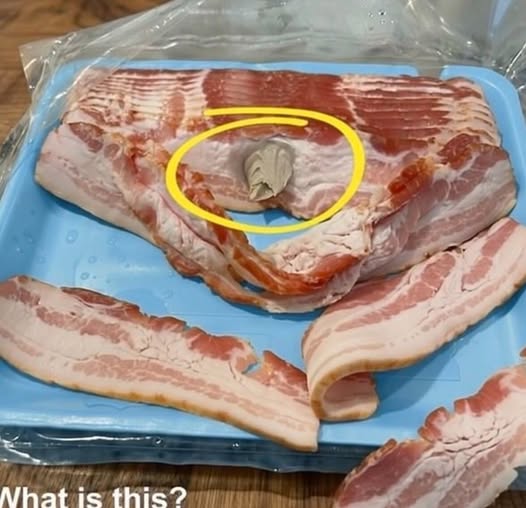
Found something unusual inside a package of bacon? Learn what an unexpected object or material could be, what to do before eating the meat, and when it’s safest to throw the package away.
I went to the store, bought a package of bacon, and brought it home looking forward to breakfast.
Everything seemed completely normal until I opened the package and pulled out a few slices.
Then I noticed something unusual mixed in with the bacon.
My appetite disappeared instantly.
I stood there staring at it, trying to figure out what I was looking at and how it could have ended up inside a sealed package of food.
What Could It Be?
Without seeing a clear photograph, it’s impossible to identify an unfamiliar object with certainty.
Something unusual found in packaged meat could potentially be a piece of packaging material, connective tissue, cartilage, a fragment of bone, or another harmless part of the processing process.
In other situations, it could be foreign material that shouldn’t have been there.
That’s why it’s better not to guess when you’re dealing with food.
Don’t Eat the Bacon Until You Know What It Is
If you find something strange inside a package of bacon or another meat product, don’t simply remove it and continue cooking the rest.
Set the package aside and avoid eating the questionable product until you’ve determined whether it is safe.
Take clear photographs of:
- The object
- The bacon around it
- The packaging
- The product label
- The lot or batch information
- The expiration or best-before date
Keeping the original packaging can be important if you decide to report the issue to the store or manufacturer.
Could It Simply Be Part of the Meat?
Sometimes something that looks alarming is actually a natural part of the animal tissue.
Fat, connective tissue, cartilage, small pieces of bone, or other structures can occasionally look very different from the surrounding meat.
That doesn’t mean every unusual object is harmless, however.
If you’re unsure, don’t rely on appearance alone.
What If It Looks Like Plastic or Metal?
If the object appears to be plastic, metal, glass, or another material that clearly doesn’t belong in the food, don’t eat the product.
Keep the object and packaging rather than throwing everything away immediately. The manufacturer or retailer may need the information to investigate the issue.
You can also report a suspected foreign-object contamination through the appropriate food-safety authority in your country.
Don’t Taste It to Find Out
This may sound obvious, but never put an unidentified object in your mouth just to determine what it is.
Even if it looks harmless, you don’t know where it came from or whether it could be contaminated.
And if you find a strange substance in raw meat, wash your hands thoroughly after handling the package and clean any surfaces that may have come into contact with the raw product.
What Should You Do With the Rest of the Package?
If you’re genuinely concerned about contamination, the safest approach is to stop using the product until you’ve received appropriate advice.
Don’t simply cook the bacon at a higher temperature to “kill” whatever the object might be. Cooking can destroy many microorganisms, but it doesn’t necessarily make an unknown foreign object safe to eat.
The Bottom Line
Finding something strange inside a package of bacon can be extremely unpleasant, but there’s no way to identify an unknown object reliably from a written description alone.
Don’t eat it, don’t taste the mystery object, and keep the packaging and product information.
If you have a clear photograph, the shape, color, texture, and size may provide important clues about what you found.
And sometimes, what looks horrifying at first turns out to be nothing more than an unusual piece of natural tissue. Other times, it really is something that shouldn’t be in the package.
Either way, when it comes to unexpected objects in food, it’s better to be cautious than sorry.