A glass-top stove can sometimes crack or shatter unexpectedly. Learn the common causes, hidden damage, thermal shock, cookware problems, and what to do safely if your cooktop suddenly breaks.
I woke up to a horrible crashing sound.
For a few seconds, I had no idea what had happened.
Then I heard my daughter calling out.
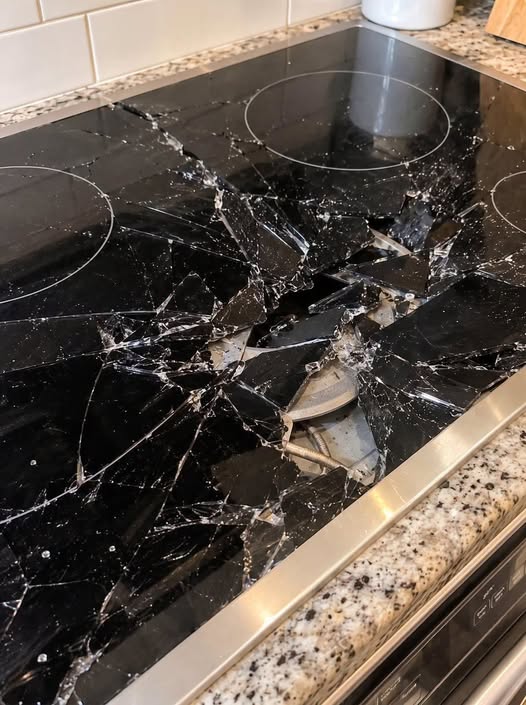
She had been preparing dinner for the children when the glass cooktop suddenly shattered.
According to her, there had been no obvious accident. Nobody had dropped anything on it. There wasn’t a loud impact beforehand. One moment everything seemed normal, and the next, the glass looked like this.
The children were terrified.
Honestly, so were we.
When a glass-top stove suddenly breaks, the first question most people ask is:
“How can glass just shatter by itself?”
The answer is that it usually isn’t truly “for no reason.” There can be damage or stress that isn’t visible until the glass finally fails.
1. A Tiny Crack May Have Been There Already
One possibility is that the cooktop had previously suffered a very small impact.
A heavy pan, pot, utensil, or another object may have struck the surface without leaving an obvious crack.
Even a tiny chip or hairline fracture around the edge can create a weak point.
The cooktop may continue working normally for days, weeks, or even longer.
Then heat causes the damaged area to expand and contract, and the glass can eventually fail.
That’s why a cooktop can appear perfectly fine immediately before breaking.
2. Thermal Shock Can Put Stress on the Glass
Rapid temperature changes can also place significant stress on glass.
For example, a very hot cooking surface can be exposed to something much colder.
Extreme temperature differences across different parts of the glass can cause expansion and contraction at different rates.
If there is already a weak spot, that stress may contribute to cracking or shattering.
This is one reason manufacturers generally recommend avoiding sudden temperature changes and using cookware appropriate for the particular cooktop.
3. Heavy or Rough Cookware Can Cause Damage
Not every pot or pan is equally suitable for a glass cooktop.
Very heavy cookware, cookware with rough or damaged bottoms, or dropping a pan onto the surface can potentially scratch, chip, or weaken the glass.
Even if the damage isn’t immediately obvious, repeated heating can make the problem worse.
When using a glass cooktop, cookware should generally be placed down gently rather than dropped or dragged across the surface.
4. A Manufacturing Defect Is Another Possibility
Sometimes the cause isn’t something the homeowner did.
Glass cooktops can have manufacturing or material defects, although these are not the most common explanation for every breakage.
If a cooktop suddenly shatters without any obvious impact, it’s worth documenting exactly what happened.
Take photographs before cleaning everything up.
Keep the model and serial number.
Check the manufacturer’s instructions and contact the manufacturer or an authorized service technician.
If the appliance is relatively new, warranty coverage may also be worth investigating.
5. Improper Installation Can Matter
Installation is another factor that shouldn’t be overlooked.
If the cooktop wasn’t installed correctly or the glass was placed under unusual mechanical stress, that stress could potentially contribute to failure.
This is particularly important if the cooktop was recently installed, replaced, or repaired.
A qualified technician can inspect the appliance and determine whether there are signs of installation-related damage.
What Should You Do If Your Glass Cooktop Shatters?
The most important thing is not to touch it immediately.
Broken glass can produce extremely sharp pieces, even when the pieces appear small.
If the cooktop is still hot, allow it to cool safely and keep children and pets away from the area.
If possible, turn off the appliance according to the manufacturer’s safety instructions and switch off the appropriate electrical supply if you can do so safely.
Don’t continue cooking on a visibly cracked or shattered glass cooktop.
Don’t Try to “Test” It
One of the biggest mistakes would be turning the stove back on just to see whether it still works.
A damaged cooktop should not be treated as safe simply because the heating elements appear functional.
The glass is part of the appliance’s designed structure, and additional heating could create more damage.
Instead, have it inspected by the manufacturer, an authorized service professional, or another qualified appliance technician.
What About the Glass Pieces?
Keep children away while the area is being dealt with.
Wear appropriate protective gloves if cleanup is necessary, and follow the appliance manufacturer’s cleaning and safety guidance.
Don’t assume that every tiny piece is harmless simply because it is difficult to see.
If glass has fallen into areas that are difficult to clean safely, professional assistance may be the better option.
Could This Have Been Prevented?
Not always.
Sometimes a cooktop fails because of damage that was impossible for the homeowner to notice beforehand.
However, there are several habits that can reduce the risk:
- Don’t drop pots or pans onto the cooktop.
- Avoid dragging rough-bottomed cookware across the surface.
- Use cookware recommended for your specific appliance.
- Don’t place extremely cold objects onto a very hot surface unless the manufacturer says it is safe.
- Inspect the cooktop regularly for chips, scratches, or cracks.
- Stop using it if you notice damage.
- Follow the manufacturer’s instructions for cookware and cleaning.
Most importantly, never ignore a small crack or chip simply because the stove still works.
The Most Frightening Part Was the Children
For my daughter, the broken stove was frightening.
But for the children, the sudden explosion-like sound was even more terrifying.
They didn’t understand why something that had looked completely normal suddenly broke into pieces.
Thankfully, everyone was okay.
And that is the most important thing.
A broken appliance can be replaced.
A child’s injury cannot.
So if your glass-top stove ever develops a crack, chip, or unusual damage, don’t wait to see what happens next.
Stop using it, keep everyone away from the area, and have it properly assessed.
Sometimes the warning sign is visible.
And sometimes, unfortunately, it isn’t.