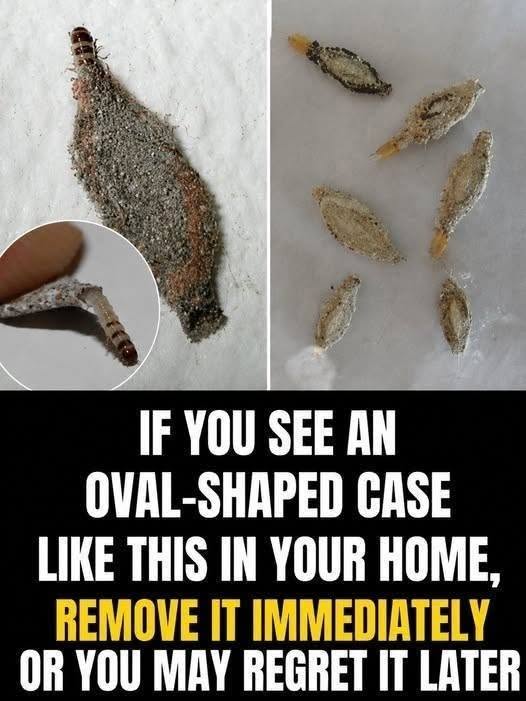
Found a strange cocoon-like object inside your home? Learn what it could be, where these insect cases are commonly found, and how to remove them safely.
Finding a small, strange cocoon attached to a wall, ceiling, curtain, cupboard, or another quiet corner of your home can be surprisingly unsettling.
At first glance, it may look like a tiny seed, piece of lint, dried leaf, or even something that has simply appeared out of nowhere.
In many cases, however, it is the protective case or pupal stage of an insect.
The good news is that most cocoon-like objects found indoors aren’t dangerous to people. But finding several of them can be a sign that your home is providing insects with a suitable place to feed, hide, or reproduce.
What Could the Strange Cocoon Be?
Several insects can create structures that look like cocoons.
Case-Bearing Moths
Some moth larvae create small protective cases from silk combined with fibers, dust, hair, or other material.
These cases may be found in quiet, undisturbed areas such as closets, carpets, storage spaces, or along walls.
The adult moth itself isn’t necessarily the problem. The larvae may feed on materials found around the home, depending on the species.
Bagworms or Casebearers
Small portable cases can sometimes belong to case-bearing moth larvae.
They may look like tiny elongated bags or pieces of debris.
Because they can be easy to overlook, seeing several cases around the home is worth investigating.
Other Insect Pupae
Some insects leave behind pupal cases or protective structures that can resemble tiny cocoons.
That’s why appearance alone isn’t always enough to identify the insect.
Should You Remove It?
If you find an unfamiliar insect case inside your home, removing it is reasonable—especially if you find more than one.
Use a tissue, paper towel, vacuum cleaner, or another method that allows you to remove it without directly handling an unknown insect.
Afterward, inspect the surrounding area.
Look for additional cases, larvae, shed skins, insects, or signs of damaged fabrics.
Where Should You Look?
Pay particular attention to areas that are dark, warm, dusty, or rarely disturbed.
Check:
- Closets
- Under furniture
- Along baseboards
- Behind curtains
- Around carpets and rugs
- Storage boxes
- Cupboards
- Garages
- Attics
- Areas containing natural-fiber fabrics
Don’t forget corners and spaces that aren’t cleaned regularly.
Why Finding Several Cases Matters
One isolated insect case doesn’t automatically mean you have an infestation.
However, finding multiple cases or larvae may indicate that insects are successfully reproducing somewhere nearby.
The next step should be finding the source rather than simply removing individual cases.
Check stored clothing, rugs, blankets, upholstery, pet bedding, and other materials where insects might find food or shelter.
Clean the Area Thoroughly
After removing the suspected cocoon, clean the surrounding area.
Vacuum carpets, corners, cracks, and underneath furniture. Empty the vacuum according to its instructions afterward.
Wash or clean fabrics according to their care labels.
For stored clothing and blankets, inspect them carefully before putting them back into storage.
Keeping storage areas dry and clean can make the environment less attractive to many household pests.
Don’t Spray Random Chemicals
A common reaction to discovering an unfamiliar insect is to immediately reach for insecticide.
That isn’t always necessary.
If you don’t know what you’re dealing with, spraying random chemicals may expose people or pets to unnecessary pesticides without solving the underlying problem.
First identify the insect if possible and determine where it is coming from.
If there is a substantial infestation, a qualified pest-control professional can help identify the species and recommend an appropriate treatment.
When Should You Be More Concerned?
Take the situation more seriously if you notice:
- Many cocoons or cases
- Live larvae
- Numerous adult insects
- Holes or damage in clothing
- Damaged carpets or fabrics
- Repeated appearances after cleaning
- Insects emerging from stored materials
These signs suggest that the object may not be an isolated visitor.
The Most Important Thing to Remember
A strange cocoon-like object in your home isn’t automatically dangerous.
The best approach is to remove it carefully, inspect the surrounding area, clean thoroughly, and watch for additional signs.
And don’t assume every unusual cocoon is the same insect. A clear photograph is often the easiest way to narrow down what you’re looking at.
If you find one, don’t panic—identify it first, then decide whether further pest control is actually necessary.