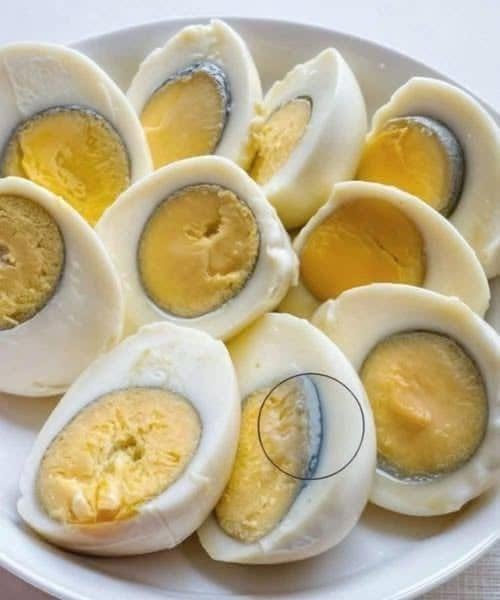
Have you ever boiled an egg, cut it open, and noticed a strange greenish or gray-green ring around the yolk?
It can look alarming, especially if you’re expecting the yolk to be bright yellow. But in most cases, that green ring is not a sign that the egg has gone bad.
Instead, it’s usually caused by a chemical reaction that happens when eggs are cooked for too long or at too high a temperature.
Why Does a Green Ring Form Around the Egg Yolk?
The green ring develops when sulfur compounds from the egg white react with iron in the yolk during cooking.
This reaction produces iron sulfide, which creates the familiar greenish-gray color around the outside of the yolk.
You’ll often see it when:
- Eggs are boiled for too long
- Eggs are cooked at excessively high temperatures
- Cooked eggs aren’t cooled promptly
- Eggs are left sitting in hot water after cooking
The longer an egg is exposed to heat, the more likely this reaction is to occur.
Does the Green Ring Mean the Egg Is Unsafe?
Not necessarily.
A green ring around an otherwise properly cooked egg is generally a cooking-quality issue rather than a food-safety warning. The egg may have a slightly different texture or flavor if it has been overcooked, but the discoloration itself doesn’t automatically mean the egg is spoiled.
However, it’s important to distinguish a cooked yolk with a green ring from an egg that shows other signs of spoilage.
How to Tell If an Egg Has Gone Bad
Color alone isn’t always enough to determine whether an egg is safe to eat.
Before using an egg, check for obvious signs of spoilage, such as:
- A strong, unpleasant sulfur-like or rotten odor
- Cracked or leaking shells
- Unusual discoloration
- Mold or unusual growth
- An abnormal appearance after cracking
If an egg smells rotten after you crack it open, don’t taste it. Discard it.
Proper storage and cooking are important parts of egg safety.
How to Prevent the Green Ring
The easiest way to avoid that unattractive green ring is to prevent overcooking.
1. Don’t Overcook Your Eggs
Once eggs have reached your preferred level of doneness, remove them from the heat.
Cooking times vary depending on egg size, starting temperature, altitude, and cooking method, so use timing as a guide rather than an absolute guarantee.
2. Cool Them Quickly
After boiling, transfer the eggs to cold or ice water.
This stops the cooking process and helps prevent the yolks from becoming overcooked.
It also makes many hard-boiled eggs easier to peel.
3. Avoid Leaving Eggs in Hot Water
One common mistake is turning off the heat and leaving the eggs sitting in hot water for a long time.
Even though the burner is off, the residual heat continues cooking the eggs.
4. Don’t Worry About a Perfectly Yellow Yolk
A thin green ring doesn’t necessarily mean you’ve done anything dangerous. It’s mainly an indication that the egg has experienced enough heat for the sulfur-and-iron reaction to occur.
The egg can still be perfectly suitable to eat if it was handled and cooked properly and shows no signs of spoilage.
What If the Entire Yolk Looks Green?
A green ring around the edge is common with overcooked hard-boiled eggs.
If the entire yolk has an unusual color, however, consider the circumstances. Different egg colors can have different causes, and unusual discoloration shouldn’t automatically be assumed to be harmless.
When in doubt, especially if there is an unusual smell or other indication of spoilage, it’s safest to throw the egg away.
The Best Way to Make Hard-Boiled Eggs
For consistently good hard-boiled eggs, use a method that gives you control over cooking time.
Place the eggs in a saucepan and cover them with water. Bring the water to a boil, then cook according to your preferred hard-boiled egg method.
Once they’re done, immediately transfer them to cold water.
After cooling, peel one and check the yolk.
A properly cooked egg should have a firm white and a yolk that’s cooked to your preferred consistency, without a pronounced green-gray ring.
Don’t Judge an Egg by the Green Ring Alone
The next time you see a green ring around your hard-boiled egg, there’s no need to panic.
That unusual color is usually the result of overcooking and a chemical reaction between sulfur in the egg white and iron in the yolk.
It doesn’t automatically mean the egg is rotten.
The bigger food-safety concerns are proper storage, handling, cooking, and signs of actual spoilage. When an egg smells bad or looks clearly abnormal in a way that suggests spoilage, don’t take chances—discard it.
So if your eggs occasionally develop that green ring, the solution may be as simple as reducing the cooking time and cooling the eggs immediately afterward.
SEO Meta Description
Found a green ring around your boiled egg yolk? Learn why it happens, whether it’s safe to eat, and how to prevent green-gray yolks when cooking eggs.