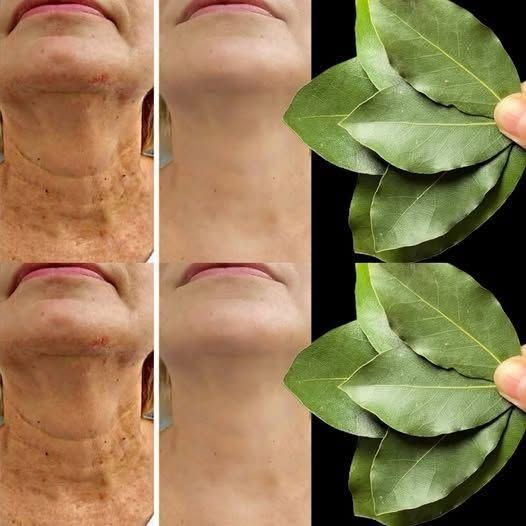
Can bay leaf really erase wrinkles and work better than Botox? Learn the truth about this popular natural remedy, how to prepare it safely, how to use it, and what science says about wrinkles and aging skin.
The claim that bay leaf is “100,000 times stronger than Botox” is eye-catching, but it is not supported by clinical evidence. Bay leaf contains plant compounds with antioxidant properties, but there is no reliable human evidence showing that a bay-leaf preparation can produce Botox-like wrinkle reduction. Botox and topical botanical remedies work very differently.
That said, if you want to try bay leaf as a simple homemade skincare treatment, there is a relatively gentle way to prepare it. Think of it as a moisturizing or refreshing skin treatment—not a replacement for medical wrinkle treatments.
What Makes Bay Leaf Interesting for Skin?
Bay leaf, particularly Laurus nobilis, contains various plant compounds, including phenolic compounds and essential oils. Some laboratory research has investigated these compounds for antioxidant and other biological activities.
Antioxidants are interesting in skincare because oxidative stress contributes to skin aging. However, laboratory evidence does not establish that rubbing bay-leaf water on the face will remove wrinkles.
So the realistic expectation is:
Bay leaf may complement a skincare routine, but it should not be described as a proven “natural Botox.”
Bay Leaf Facial Remedy: Step by Step
Step 1: Gather the ingredients
You can keep the preparation simple:
- 3–5 dried culinary bay leaves
- 1 cup (about 240 ml) of clean water
- A clean saucepan
- A clean glass container with a lid
- Cotton pads or clean fingertips
Avoid using concentrated bay-leaf essential oil directly on your face. Essential oils can irritate the skin, particularly sensitive or mature skin.
Step 2: Prepare the bay-leaf water
- Place approximately 1 cup of water in a clean saucepan.
- Add 3–5 dried bay leaves.
- Bring the water to a gentle boil.
- Reduce the heat and simmer for approximately 5–10 minutes.
- Turn off the heat and allow the liquid to cool completely.
- Remove the leaves.
- Transfer the cooled liquid to a clean container.
Don’t apply hot liquid to your skin.
Step 3: Perform a patch test
This step is especially important with homemade preparations.
Apply a small amount to an inconspicuous area of skin, such as the inner forearm. Wait and monitor the area for irritation.
The American Academy of Dermatology recommends testing skincare products on a small area before applying them more widely, because even products marketed as gentle or natural can cause reactions.
If you develop burning, significant redness, swelling, itching, or a rash, wash the area and don’t use the preparation on your face.
Step 4: Apply it to the face
If the patch test causes no reaction:
- Wash your face with a gentle cleanser.
- Pat your skin dry.
- Apply a small amount of the cooled bay-leaf water with clean fingertips or a cotton pad.
- Avoid the eyes, eyelids, lips, and broken or irritated skin.
- Allow the skin to dry naturally.
- Follow with a gentle moisturizer.
You don’t need to saturate your face. More product does not necessarily mean better results.
Step 5: Start slowly
For a homemade preparation without established clinical dosing, don’t overuse it.
A cautious approach would be to try it once or twice a week initially and discontinue it if irritation develops.
Because there isn’t good clinical evidence establishing an effective concentration or frequency for bay-leaf water as an anti-wrinkle treatment, there is no scientifically established schedule that can guarantee wrinkle reduction.
Can You Add Honey or Aloe Vera?
You may see recipes recommending bay-leaf water mixed with ingredients such as honey, aloe vera, lemon juice, or yogurt.
I’d avoid making the recipe unnecessarily complicated.
Do not add lemon juice to a facial treatment. Citrus products can irritate skin and may increase the risk of unwanted reactions after sun exposure.
If you want additional hydration, using a properly formulated, fragrance-free moisturizer is a more predictable option.
What About Wrinkles at Age 70?
Yes, people in their 60s, 70s, and beyond can still improve the appearance and texture of their skin.
But the goal should be healthier-looking, better-hydrated skin and softer-looking fine lines, rather than expecting a home remedy to completely erase established wrinkles.
The American Academy of Dermatology recommends daily broad-spectrum sunscreen with SPF 30 or higher, moisturizing, avoiding tanning, and using appropriate anti-aging products.
A simple morning routine
1. Gentle cleanser → 2. Moisturizer → 3. Broad-spectrum SPF 30+
Sun protection is particularly important because ultraviolet exposure accelerates skin aging and contributes to wrinkles and age spots. A simple evening routine
1. Gentle cleanser → 2. Appropriate anti-aging product → 3. Moisturizer
Retinoids/retinol have substantially more evidence for improving fine lines and wrinkles than homemade bay-leaf preparations. The AAD notes that retinoids can improve skin tone and reduce fine lines and wrinkles, although they can also cause irritation and aren’t appropriate for everyone.
Bay Leaf vs. Botox: What’s the Difference?
The comparison is important.
| Bay-leaf preparation | Botox |
|---|---|
| Topical/home remedy | Medical injection |
| Evidence for wrinkle reduction is limited | Clinically established cosmetic treatment |
| Does not specifically relax facial muscles | Temporarily reduces targeted muscle activity |
| May provide a refreshing/moisturizing skincare experience | Can reduce certain dynamic wrinkles |
| Results, if any, are unpredictable | Results are clinically evaluated |
| Can cause skin irritation | Has medical risks and should be administered by qualified professionals |
Dermatologists recognize Botox, prescription retinoids, moisturizers, chemical peels, laser treatments, and other procedures as options for treating signs of skin aging.
Therefore, “100,000 times stronger than Botox” should not be presented as a medical fact.
Important Safety Tips
Before trying any homemade facial remedy:
- Don’t apply it to broken, sunburned, or inflamed skin.
- Keep it away from your eyes.
- Perform a patch test first.
- Don’t use concentrated bay-leaf essential oil directly on your face.
- Stop immediately if you develop burning, swelling, itching, or a rash.
- Don’t expect it to eliminate deep wrinkles.
- Store homemade preparations hygienically and discard them if their appearance, smell, or texture changes.
Older skin can be particularly vulnerable to dryness and irritation, so gentle skincare is usually preferable to aggressive DIY treatments.
The Real Secret to Younger-Looking Skin
If your goal is to reduce wrinkles, a consistent routine is more useful than searching for a miracle ingredient.
Morning:
Cleanse → moisturize → SPF 30+
Evening:
Cleanse → evidence-based anti-aging product if appropriate → moisturize
And remember that results take time. The AAD notes that many skincare products require at least several weeks—and sometimes several months—to show their full effect.
Final Verdict
Bay leaf can be an interesting traditional skincare ingredient, but there is no scientific basis for saying it is 100,000 times stronger than Botox. A homemade bay-leaf preparation may be used cautiously as an optional skincare treatment, but it should not replace sunscreen, proven topical treatments, or professional dermatological care.
For someone wanting to improve wrinkles naturally, sun protection, moisturization, gentle skincare, and appropriately selected evidence-based ingredients such as retinoids are much more defensible choices than a “miracle Botox” claim.