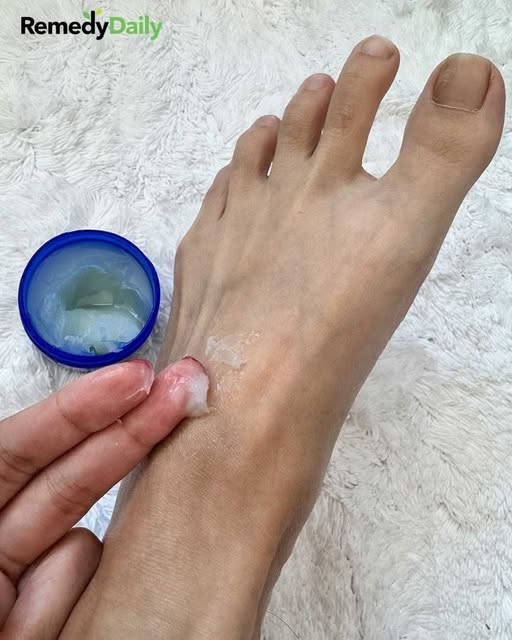
Why do some people rub Vicks VapoRub on their feet before bed? Discover where this popular remedy came from, what it may actually do, what it cannot do, and how to use Vicks safely.
There are countless old-fashioned home remedies that sound strange until you understand where they came from.
One of the most talked-about is rubbing Vicks VapoRub on the soles of the feet before going to bed.
Some people swear by this nighttime ritual. They say it helps them feel more comfortable, especially when they’re dealing with a cough, congestion or dry, tired feet.
Others insist that putting Vicks on the feet can somehow make a cough disappear overnight.
But is there really something special about the soles of the feet?
The answer is more interesting than a simple yes or no.
Why Do People Put Vicks on Their Feet?
Vicks VapoRub is a topical ointment traditionally used on the chest and throat to temporarily relieve cough associated with the common cold.
Its familiar ingredients include camphor, eucalyptus oil and menthol.
The product’s official directions focus on using it on the chest and throat for cough relief—not on the feet.
So why did the foot remedy become so popular?
Much of it appears to come from family traditions and word-of-mouth.
Someone tries it, believes they feel better, and passes the trick along to another person.
Eventually, the remedy becomes a household tradition.
But there’s an important distinction:
A traditional remedy can feel comforting without having the specific medical effect people claim for it.
Does Rubbing Vicks on Your Feet Stop a Cough?
This is the biggest claim surrounding the practice.
You’ll often hear that putting Vicks on your feet and covering them with socks will stop a nighttime cough.
However, there isn’t good clinical evidence showing that applying Vicks to the soles of the feet treats a cough.
In other words, there is no established medical mechanism showing that rubbing the ointment onto your feet makes its ingredients travel from the soles directly to the respiratory system.
That’s an important myth to clear up.
If someone says, “It worked for me,” their experience may be genuine—but that doesn’t prove that the foot application itself treated the underlying cough.
A cough can naturally change throughout the night, and other things happening at the same time—warmth, rest, hydration or simply the passage of time—can influence how a person feels.
So Why Might It Feel Good?
There are several perfectly reasonable explanations for why someone might enjoy the ritual.
The Menthol Sensation
Menthol produces a characteristic cooling sensation on the skin.
That sensation can make you feel as though your nasal passages are more open, even though it doesn’t necessarily mean that physical nasal obstruction has disappeared.
The Warm Socks
After applying an ointment and putting on socks, your feet stay warm.
For some people, that simple warmth is relaxing.
And if the routine happens immediately before bed, the ritual itself may become associated with winding down.
The Strong Aroma
The smell of menthol and eucalyptus can be noticeable and comforting to people who enjoy those aromas.
Again, enjoying the scent doesn’t mean the ointment is treating an infection.
The More Practical Reason to Put Vicks on Your Feet
There is one reason the practice can make sense even without the dramatic cough claims.
Dry feet.
Vicks is an ointment with a thick, moisturizing base.
Applying a small amount to dry areas of the feet and then wearing clean cotton socks can help reduce the feeling of dryness by creating an occlusive layer over the skin.
If your heels are rough or dry, an appropriate foot moisturizer is generally a more straightforward choice.
You don’t need Vicks specifically for ordinary dry skin.
A dedicated foot cream containing ingredients such as urea can often be more appropriate for persistent thick or cracked skin.
What Happens When You Put Socks Over It?
The socks aren’t a magical part of the remedy.
They can simply help keep the ointment in place.
Without socks, some of the product can rub onto your bedding.
With socks, the ointment remains in contact with the skin for longer.
This can also make the experience feel warmer and more comfortable.
However, don’t wrap your feet tightly or create excessive heat.
Comfort is the goal.
Is It Safe?
For many adults, topical Vicks can be used safely when the product directions are followed.
But “natural” or “old-fashioned” doesn’t automatically mean risk-free.
Vicks contains active ingredients that can cause problems if misused.
Never Eat It
Vicks VapoRub is intended for external use.
It should not be swallowed.
Camphor can be toxic when ingested, particularly in children.
Keep the container securely away from children and pets.
Don’t Put It on Broken Skin
Avoid applying it to:
- Open wounds
- Cuts
- Scratches
- Irritated skin
- Severe rashes
- Burns
If the skin is cracked and bleeding, choose an appropriate wound-care or moisturizing product instead.
Don’t Put It Inside Your Nose
This is particularly important.
Vicks should not be placed inside the nostrils.
The product is designed for external use according to its labeling.
Avoid the Eyes
Keep the ointment away from the eyes and other sensitive areas.
Wash your hands after application.
What About Babies and Young Children?
Extra caution is necessary with children.
Products containing camphor can be dangerous if swallowed, and topical products should always be used according to the specific age restrictions and instructions on their packaging.
Never assume that something safe for an adult is automatically safe for an infant.
For babies and young children with coughing or breathing symptoms, follow pediatric medical advice rather than experimenting with traditional remedies.
Could Vicks Irritate Your Feet?
Yes.
Some people may experience irritation or sensitivity to topical ingredients.
If you notice:
- Burning
- Stinging
- Severe redness
- Rash
- Swelling
- Blistering
wash the area and stop using the product.
A pleasant cooling sensation is one thing.
Painful burning is not a sign that the remedy is “working.”
What If You Have Diabetes?
People with diabetes need to be particularly careful with foot care.
Reduced sensation or circulation problems can make small foot injuries more serious.
If you have diabetes, neuropathy, poor circulation or chronic foot problems, don’t routinely experiment with irritating topical products without discussing appropriate foot care with your healthcare professional.
Inspect your feet regularly and take persistent cracks, sores or infections seriously.
What About Athlete’s Foot?
This is another area where people sometimes make exaggerated claims.
Vicks is not a first-line treatment for athlete’s foot.
If you have itching, scaling, cracking or a persistent rash between the toes, an appropriate antifungal treatment may be needed.
Keeping feet clean and dry is also important.
If the rash doesn’t improve or keeps returning, speak with a healthcare professional.
The Bedtime Ritual May Be the Real “Secret”
There’s another reason this remedy may have become so popular.
Bedtime rituals matter.
A person who applies ointment, puts on clean socks, gets comfortable under a blanket and settles down for the night may simply be creating a relaxing routine.
The ritual tells the brain:
“It’s time to slow down.”
That doesn’t mean the Vicks itself has a special sleep-inducing property.
It means that consistent nighttime habits can become associated with relaxation.
You could create a similar routine with a regular foot moisturizer, clean socks and a few minutes of quiet time.
What Vicks Is Actually Designed to Do
This is perhaps the most important point.
Vicks VapoRub is formulated as a topical cough suppressant for temporary relief of cough associated with the common cold when used as directed.
Its traditional application is on the chest and throat.
That is different from saying that rubbing it on the feet treats a cough.
So if you’re using Vicks for a cold, follow the instructions on the specific product label.
Don’t assume that an internet remedy is equivalent to the manufacturer’s recommended use.
A Better Way to Think About the Foot Trick
Instead of saying:
“Vicks on your feet cures a cough.”
A more accurate description would be:
“Some people find applying Vicks to their feet before bed comforting, but there is no good evidence that this particular application stops a cough.”
That’s a much more useful way to look at the tradition.
You can enjoy a comforting bedtime ritual without turning it into a medical promise.
If You Want to Try It
If you’re an adult and the product labeling allows its use for your situation, keep the routine simple.
- Wash and dry your feet.
- Apply a small amount to intact skin.
- Avoid cuts, irritated areas and sensitive skin.
- Put on clean, loose-fitting socks if desired.
- Wash your hands afterward.
- Stop if irritation develops.
There’s no need to apply a thick layer.
More product doesn’t automatically mean better results.
When a Cough Needs Medical Attention
Don’t rely on a foot remedy if a cough is accompanied by warning signs.
Seek prompt medical attention for symptoms such as:
- Difficulty breathing
- Severe shortness of breath
- Chest pain
- Coughing up blood
- Bluish or gray lips
- Confusion
- Severe weakness
- A cough that is worsening significantly
- Persistent high fever or other concerning symptoms
Young children, older adults and people with significant underlying medical conditions may need medical advice sooner.
The Bottom Line
The story of rubbing Vicks VapoRub on the feet before bed is a fascinating example of how household remedies spread from one generation to another.
There is no strong evidence that applying Vicks to the soles of the feet stops a cough or provides a special pathway for the ingredients to treat respiratory symptoms.
However, the ritual may still feel comforting because of the ointment’s cooling sensation, its strong aroma, warmth from socks and the relaxing routine associated with bedtime.
And for dry feet, an ointment can provide moisturizing benefits—but you don’t necessarily need Vicks for that.
So if your grandmother taught you this trick, you don’t have to throw the tradition away.
Just keep the expectations realistic.
Use topical products according to their labels, protect your skin, and don’t substitute an internet remedy for medical treatment when symptoms are serious.
Sometimes an old household trick doesn’t need to be a miracle to be worth keeping.
It simply needs to make you feel a little more comfortable at the end of the day.