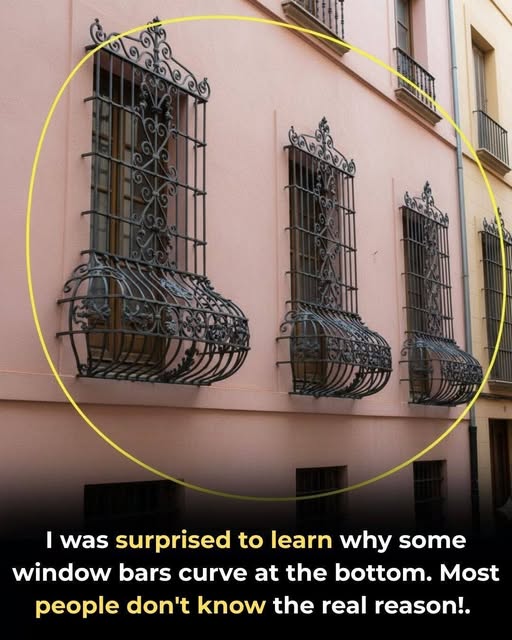
Ever wondered why some window bars curve outward at the bottom? These distinctive wrought-iron guards aren’t simply decorative. Discover the practical history behind their unusual shape and why they’re common in traditional architecture.
Many People Think It’s Decoration! The Real Reason Some Window Bars Curve at the Bottom
At first glance, the curved ironwork around these windows looks like an elaborate piece of decoration. The intricate patterns certainly make the building look beautiful—but the outward-curving lower section has a practical purpose too.
These unusual window guards are a traditional architectural feature found in various parts of Europe, Latin America, and other regions influenced by Mediterranean and Spanish architectural traditions.
So why don’t the bars simply stay flat against the wall?
🪟 The Curved Shape Creates Extra Space
The most important reason is simple: the bars project outward from the window, creating a small usable space in front of it.
Instead of having a flat metal grille immediately against the window, the lower portion forms a shallow cage-like projection.
This can make it possible for someone to:
- Open the window more comfortably
- Lean toward the outside
- Get closer to the opening without removing the protective bars
- Place small decorative plants or objects in some designs
- Enjoy better airflow through the window
In some architectural traditions, these projecting window guards effectively function as a very small balcony or “French balcony”, even though they aren’t large enough to stand on like a conventional balcony.
🔒 Protection Without Completely Closing Off the Window
Historically, window bars had an important security function.
A conventional flat grille provides protection, but it can make a window feel enclosed. A projecting design provides a little more usable space while still maintaining a barrier between the interior and the street.
This was particularly useful for windows on lower floors or buildings facing public streets.
The bars could therefore combine security, ventilation, accessibility, and architectural style in a single feature.
🌬️ They Also Allow the Window to Open
Imagine a flat iron grille installed directly across a window.
When the window is opened, the person inside is still separated from the outside by the bars.
With a projecting grille, there is additional space immediately outside the opening. Depending on the particular design, this can make the window more functional while maintaining the protective barrier.
That was especially valuable before modern security systems, alarms, cameras, and reinforced windows existed.
🌿 And Yes—People Sometimes Used Them for Plants
There’s another reason these curved structures can look like miniature balconies: they can be used to hold flower pots and plants.
In older homes, projecting ironwork could provide a convenient place for plants while keeping them secured outside the window.
However, it’s important not to assume that every curved window grille was specifically designed as a flower holder. Their exact purpose varies according to the building, region, and historical period.
🏛️ A Feature With a Long Architectural History
Ornamental iron window guards became especially characteristic of historic architecture in places where wrought iron was widely used.
Blacksmiths could turn relatively ordinary protective bars into highly decorative architectural elements using:
- Curves
- Spirals
- Floral motifs
- Geometric patterns
- Leaves and scrollwork
- Repeating decorative shapes
The result was something that served a practical purpose while also becoming part of the building’s identity.


🤔 So Is It Just Decoration?
No—but decoration is definitely part of it.
The curved shape can provide practical benefits, while the elaborate ironwork reflects the craftsmanship and aesthetic preferences of the period.
That’s what makes these architectural details so interesting: something that looks ornamental can also have a functional purpose.
⚠️ One Important Detail
There isn’t one universal explanation for every outward-curving window grille around the world.
Some were primarily intended for security, some created a small projecting space, some accommodated plants or decorative objects, and others were designed largely for architectural effect.
The exact purpose depends on the building’s location, age, design, and historical context.
The Fascinating Part
Today, we tend to separate architecture into two categories: beautiful and useful.
Historic buildings often didn’t make that distinction.
A skilled blacksmith could create a window guard that protected the occupants, allowed the window to function, provided a little extra space, and transformed an ordinary façade into something memorable.
So the next time you see one of these curved window bars, don’t just look at the decoration.
Look at the shape.
That outward curve may be telling you something about how people once used the window—and how architecture solved everyday problems long before modern technology existed.