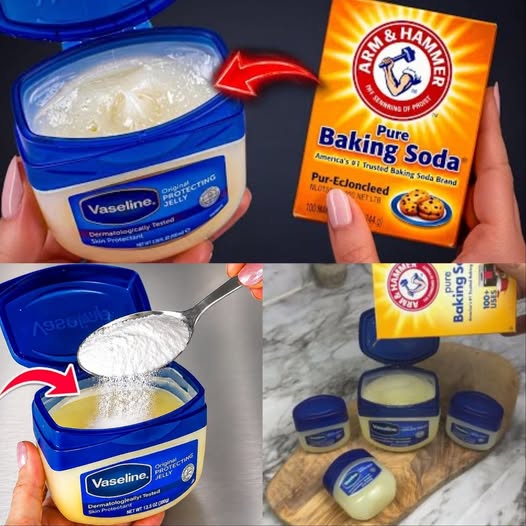
Discover how a simple mixture of baking soda and petroleum jelly can be used as a gentle skin-care preparation, plus important safety tips for sensitive skin.
Baking soda and petroleum jelly are two inexpensive household products that many people already have at home. Online, you’ll often see claims that mixing them together can transform the skin, remove dark spots, smooth wrinkles, or provide dramatic beauty results.
The reality is more modest: petroleum jelly can help protect and moisturize dry skin, while baking soda is alkaline and mildly abrasive. The combination isn’t a proven treatment for wrinkles, pigmentation, acne, or other skin conditions.
Still, if you’re interested in trying it as a simple occasional skin-softening preparation, here’s a cautious way to approach it.
A Simple Baking Soda and Vaseline Mixture
Ingredients
- 1 teaspoon plain petroleum jelly, such as Vaseline
- ¼ teaspoon baking soda
How to Prepare It
- Place the petroleum jelly in a clean, small container.
- Add a small amount of baking soda.
- Mix thoroughly until the powder is evenly distributed.
- Use the mixture immediately rather than storing a homemade preparation for a long time.
Because baking soda can be irritating for some people, using only a small amount is important.
How to Use It
Apply a very thin layer to a small area of clean, dry skin.
Don’t vigorously scrub. Baking soda’s texture can create friction, and aggressive rubbing can irritate the skin.
Leave it on briefly, then gently rinse if your skin feels uncomfortable. If your skin tolerates the mixture well, you can simply use petroleum jelly afterward as a moisturizer.
What Does Vaseline Actually Do?
Petroleum jelly is an occlusive moisturizer. It forms a protective layer over the skin that helps reduce water loss.
This makes it particularly useful for dry areas such as:
- Elbows
- Heels
- Knees
- Dry hands
- Chapped skin
It doesn’t “erase” wrinkles or permanently change your skin, but keeping the skin well moisturized can make it temporarily appear smoother.
What About Baking Soda?
Baking soda has a mildly abrasive texture and an alkaline pH.
That’s why it sometimes appears in homemade exfoliating recipes. However, the skin has a naturally acidic environment, and applying alkaline substances can disturb the skin barrier.
For that reason, baking soda isn’t an ideal everyday facial exfoliant.
If you have sensitive, dry, eczema-prone, or easily irritated skin, it’s better to skip this mixture.
Don’t Use It Around Your Eyes
Keep baking soda mixtures away from the eyes and eyelids.
The skin in this area is particularly delicate, and accidental contact can cause significant irritation.
Also avoid applying the mixture to:
- Open wounds
- Sunburned skin
- Freshly shaved or waxed skin
- Active rashes
- Broken or irritated skin
Always Patch-Test First
Before applying any homemade skin-care mixture to a larger area, test a tiny amount on an inconspicuous area of skin.
Wait and see how your skin reacts.
If you experience burning, redness, itching, swelling, or persistent irritation, wash it off and discontinue use.
A Safer Alternative for Dry Skin
If your main goal is simply to soften dry skin, you don’t necessarily need baking soda.
Plain petroleum jelly applied to slightly damp skin can be a much simpler option.
For facial skin, a fragrance-free moisturizer formulated for your skin type is generally a better everyday choice than homemade baking-soda mixtures.
The Bottom Line
The combination of baking soda and Vaseline may sound like a miracle beauty hack, but there is no good evidence that it removes wrinkles, permanently lightens dark spots, or cures acne.
The useful ingredient here is mainly the petroleum jelly, which helps protect and reduce moisture loss from dry skin.
If you choose to experiment with the mixture, use very little baking soda, avoid vigorous scrubbing, patch-test first, and stop immediately if irritation occurs.
Sometimes the simplest beauty routine is also the safest one.