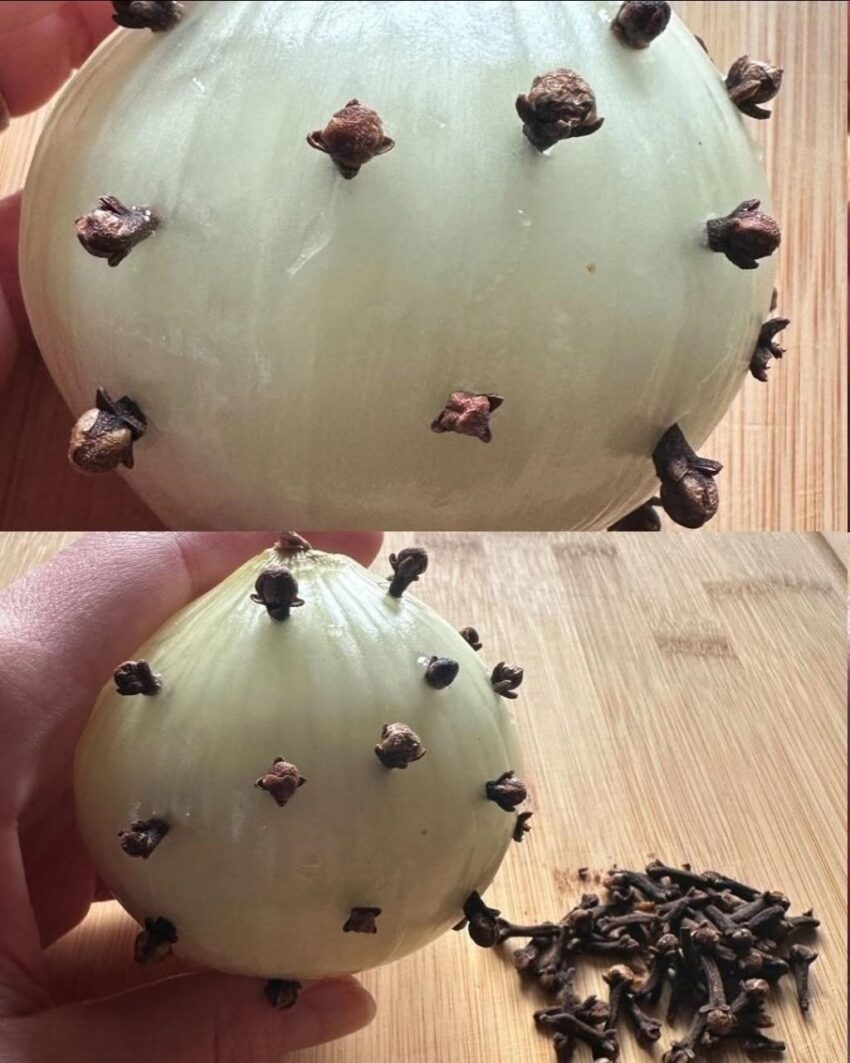
Discover why French cooks stick whole cloves into an onion. Learn the traditional oignon piqué technique, how it flavors soups, sauces and stews, and how to use it at home.
My French grandmother had a little kitchen habit that I never understood.
Whenever she was making a soup, sauce or slow-cooked dish, she would take an ordinary onion and stick several whole cloves into it.
At first, I thought it was simply an old-fashioned cooking ritual.
Then I tasted the food.
The broth had a subtle warmth. The sauce had more depth. Nothing tasted strongly of cloves, yet there was something extra in the background that made the whole dish taste more complete.
That was when I finally asked her:
“Why do you put cloves in the onion?”
Her answer was simple:
“Because it makes the food taste better—and you can take everything out easily afterward.”
And she was absolutely right.
This traditional French technique is called oignon piqué, which essentially means an onion studded with cloves. It is a classic way of gently infusing dishes with the aromatic flavor of cloves and onion. The combination appears in traditional French preparations including béchamel and various broths and stews.
What Exactly Is an Oignon Piqué?
An oignon piqué is simply an onion into which whole cloves have been inserted.
Sometimes a bay leaf is also secured against the onion with the cloves.
The onion is then placed into the pot while the dish cooks.
Instead of chopping the onion into tiny pieces and scattering cloves throughout the food, everything remains together as one little aromatic bundle.
When the cooking is finished, you simply remove the onion.
That’s the clever part.
You get the flavor without having to hunt through the finished dish for individual cloves.
Why Put Cloves Into an Onion?
There are several practical reasons.
1. It Adds a Subtle Warm Spice
Whole cloves have a powerful, distinctive aroma.
Used on their own in large quantities, they can easily overpower a dish.
But when just a few cloves are inserted into an onion and gently simmered, their flavor becomes much more subtle.
Instead of screaming “clove,” they provide a warm, slightly sweet and aromatic background note.
That’s particularly useful in delicate sauces and broths.
2. The Onion Adds Savory Depth
Onion naturally contributes sweetness and savory flavor as it cooks.
When the onion slowly simmers with the cloves, the flavors mingle.
The result isn’t supposed to taste like spiced tea or a Christmas dessert.
Instead, the combination can make a broth or sauce taste more rounded and complex.
3. It Keeps the Cloves Contained
This is perhaps the most practical reason.
Cloves are small and hard.
If you simply throw several into a pot, you eventually have to find them.
And biting unexpectedly into a whole clove isn’t particularly pleasant.
By sticking the cloves into an onion, you create a natural container.
Once the cooking is complete, remove the onion and the cloves disappear with it.
The French Name: Oignon Piqué
If you come across the term oignon piqué in a French recipe, don’t be intimidated.
It simply refers to this technique.
A traditional version can involve:
- An onion
- Whole cloves
- A bay leaf
The cloves may be pushed through the bay leaf and into the onion, helping hold the leaf in place.
This preparation is particularly associated with classic French sauces and slow-cooked dishes. Traditional béchamel recipes, for example, can use an onion piqué to infuse the milk before the sauce is finished.
The Classic Béchamel Trick
One of the best places to appreciate this technique is béchamel sauce.
Béchamel is made from a simple combination of milk, butter, flour and seasonings.
But French cooks have long used aromatics to give the milk more character.
A classic approach is to gently heat milk with an onion studded with cloves and a bay leaf.
The milk absorbs the aromas.
The onion is then removed before the infused milk is incorporated into the sauce.
This creates a subtle background flavor rather than pieces of onion or whole spices floating around the finished dish.
And that’s exactly what makes the trick so clever.
The ingredient doesn’t have to remain in the finished dish to contribute its flavor.
How to Make an Onion Studded With Cloves
It’s incredibly easy.
You’ll Need
- 1 medium yellow or white onion
- 3–6 whole cloves
- 1 bay leaf, optional
Step 1: Peel the Onion
Remove the dry outer skin.
Leave the onion whole.
There’s no need to chop it.
Step 2: Add the Cloves
Take the whole cloves and push them firmly into the onion.
For a mild flavor, start with about 3 cloves.
For a larger pot of broth or stew, you can use 4–6.
Remember that cloves are potent.
You don’t need a handful.
Step 3: Add the Bay Leaf
If you’re using a bay leaf, place it against the onion and push the cloves through the leaf and into the onion.
This creates a compact little aromatic package.
Step 4: Put It Into the Pot
Add the onion to your soup, broth, sauce or stew.
Allow it to gently simmer.
Step 5: Remove Before Serving
When your dish is finished, simply lift out the onion.
Discard the onion, cloves and bay leaf, or use the onion separately if your recipe calls for it.
That’s it.
Where Can You Use This Trick?
This isn’t just a trick for one recipe.
It can be useful in many slow-cooked dishes.
Béchamel Sauce
This is one of the classic applications.
Infuse the milk with the onion piqué before making the sauce.
The result is a gently aromatic white sauce.
Soups
Add the onion to creamy vegetable soups, bean soups or other mild broths when you want a little extra depth.
Beef Broth
French-style beef preparations often use an onion studded with cloves alongside other aromatics.
The cloves add warmth without requiring ground spices. Traditional pot-au-feu recipes, for example, commonly include onion, cloves and a bouquet garni.
Beef Bourguignon
The same technique can be used in hearty beef dishes.
A few cloves can complement the richness of the beef and other aromatic ingredients.
Bean Dishes
An onion piqué can also be added to beans while they cook.
The onion and clove combination provides a gentle aromatic character without leaving individual spices throughout the dish.
Chicken or Vegetable Stock
If you’re making homemade stock, this is an easy way to introduce another layer of flavor.
How Many Cloves Should You Use?
This is where many people make a mistake.
More isn’t necessarily better.
Cloves are extremely aromatic.
For a medium onion, around 3–6 whole cloves is a good starting point for many recipes.
If you’re making a small sauce, you may only need 2–3.
For a large stockpot, you can use a few more.
The goal is subtle fragrance—not a dish that tastes overwhelmingly like cloves.
Why Not Just Add Ground Cloves?
Because the purpose is different.
Ground cloves disperse throughout the entire dish.
Once they’re added, you can’t easily remove them.
An onion piqué allows the flavor to infuse gradually while keeping the spice contained.
This gives you much more control.
It’s especially useful for dishes where you want a delicate flavor.
The Secret Is in the Slow Cooking
Don’t think of the onion piqué as an ingredient that needs to be fried or browned.
Its job is primarily to infuse.
Place it into the liquid and allow the dish to simmer.
As the liquid heats, aromatic compounds from the onion and cloves gradually contribute their fragrance and flavor.
That’s why this technique works particularly well in soups, sauces and long-cooked dishes.
Why Your Grandmother May Have Loved This Technique
Older cooking traditions often relied on simple ingredients and clever techniques rather than dozens of seasonings.
An onion was inexpensive.
Cloves could be stored for a long time.
A bay leaf was easy to keep in the pantry.
Together, they could transform a plain cooking liquid into something much more aromatic.
And because the onion could be removed at the end, the finished dish remained smooth and elegant.
That’s the kind of practical kitchen wisdom that gets passed from one generation to another.
It’s Not Just About Flavor
You may see claims online that putting cloves into an onion creates some kind of powerful medicinal remedy.
That’s not what this traditional technique is about.
The primary culinary purpose is flavor.
Cloves contain aromatic compounds and have a long history of culinary and traditional use, but an onion studded with cloves should be thought of as a cooking technique—not a medical treatment.
If you’re making this, you’re doing it because it makes your food smell and taste better.
And honestly, that’s enough.
My Favorite Way to Try It
If you’ve never used an onion piqué before, start with something simple.
Make a basic creamy white sauce.
Take:
- 2 cups milk
- ½ onion
- 3 whole cloves
- 1 bay leaf
- 2 tablespoons butter
- 2 tablespoons flour
- Salt
- A little nutmeg, if desired
Stud the onion with the cloves and bay leaf.
Warm the milk gently with the onion piqué.
Don’t aggressively boil it.
Let the aromatics infuse for roughly 10–20 minutes, depending on the recipe.
Remove the onion.
Then prepare your butter-and-flour roux and gradually whisk in the infused milk.
Season to taste.
You’ll notice that the finished sauce doesn’t necessarily taste “clove-flavored.”
Instead, it simply tastes more interesting.
That’s the magic of subtle seasoning.
A Few Mistakes to Avoid
Don’t Use Too Many Cloves
Five cloves can provide plenty of flavor.
Twenty cloves may turn your soup into something entirely different.
Don’t Crush the Cloves
Use whole cloves.
Their purpose here is controlled infusion.
Don’t Forget to Remove Them
Whole cloves are hard and unpleasant to bite into.
Always remove the onion and its aromatics before serving unless the recipe specifically says otherwise.
Don’t Expect a Strong Clove Flavor
The best onion piqué is often the one you barely notice.
People may simply say:
“Why does this taste so good?”
That’s the point.
The Old-Fashioned Trick Worth Bringing Back
There are plenty of complicated cooking techniques that require expensive equipment or unusual ingredients.
This isn’t one of them.
You need an onion.
You need a few cloves.
And, optionally, a bay leaf.
That’s it.
Yet this tiny preparation can add a surprisingly sophisticated layer of flavor to soups, sauces, stocks and stews.
French cooks didn’t necessarily need dozens of spices to create depth.
Sometimes they simply knew how to use a few ingredients intelligently.
So the next time you’re making soup, béchamel, stock or a slow-cooked stew, don’t just throw the cloves into the pot.
Try your grandmother’s way.
Peel an onion.
Stick a few cloves into it.
Add it to the pot.
Let everything simmer.
Then remove it before serving.
You may find yourself wondering the same thing I did:
“Why didn’t anyone teach me this sooner?”
The Bottom Line
Putting cloves into an onion isn’t a strange superstition or a secret medical remedy.
It’s a classic flavoring technique.
The onion acts as a convenient aromatic base, while the cloves slowly release their warm, spicy fragrance into the cooking liquid. A bay leaf can be added as well, creating the traditional oignon piqué used in French-style sauces, stocks and slow-cooked dishes.
It’s simple, inexpensive and remarkably practical.
And perhaps that’s why these little kitchen traditions survive for generations.
Sometimes the best cooking secrets aren’t complicated at all.
They’re just the tricks our grandmothers already knew.