When my husband told me he was going to have a vasectomy, I believed it was the end of one chapter of our lives.
We already had children. We had talked about our future, our finances, our responsibilities, and the fact that neither of us wanted to start over with another baby.
The decision wasn’t easy, but after months of conversations, we finally agreed.
My husband had the procedure.
He came home sore but relieved, joking that our days of worrying about an unexpected pregnancy were finally over.
I believed him.
I believed the doctor.
I believed that everything had gone according to plan.
So when my period was late two months later, pregnancy was the last thing on my mind.
At first, I blamed stress.
Then I blamed exhaustion.
But when the nausea started, followed by the strange tenderness in my breasts and the overwhelming fatigue, a tiny voice inside me began asking a question I didn’t want to hear.
Could I actually be pregnant?
I bought a pregnancy test and waited until my husband was at work.
When the second line appeared, my hands began shaking.
I stared at it for what felt like several minutes.
Then I took another test.
Positive.
I took a third.
Positive again.
My heart dropped.
I wasn’t just surprised.
I was terrified.
Because I knew exactly what my husband would think.
“That’s Impossible.”
When I told him that evening, he stared at me without saying anything.
I handed him the pregnancy test.
He looked at it.
Then he looked at me.
His expression changed completely.
“That’s impossible,” he said.
“I know,” I whispered.
“You know I had the surgery.”
“I know.”
He walked away from me.
For several minutes, neither of us spoke.
Then he turned around.
“Who is he?”
I felt like I’d been slapped.
“What?”
“Don’t pretend you don’t understand.”
My eyes filled with tears.
“There is no one.”
He shook his head.
“You’re pregnant. I had a vasectomy.”
“I didn’t cheat on you.”
But he wasn’t listening anymore.
To him, the math seemed simple.
He had undergone a procedure intended to prevent pregnancy.
I was pregnant.
Therefore, someone else had to be responsible.
What he didn’t understand — and what neither of us had properly considered — was that a vasectomy does not make a man immediately sterile.
Medical guidelines recommend using another form of contraception until a post-vasectomy semen analysis confirms that the procedure has been successful. The CDC recommends semen analysis around 8–16 weeks after the procedure.
But at that moment, none of that mattered to my husband.
He was hurt.
I was frightened.
And our marriage was suddenly hanging by a thread.
The Test He Never Took
The doctor had told my husband to return for a semen analysis.
But he hadn’t gone.
He kept saying he felt fine.
He assumed the procedure had worked.
We both assumed it.
That assumption suddenly seemed enormous.
The American Urological Association explains that sperm can remain in the reproductive tract for weeks after a vasectomy. Patients are advised to use other contraception until semen testing confirms that there are no sperm or only rare non-moving sperm.
So medically, my pregnancy wasn’t proof that I had been unfaithful.
But emotionally, my husband couldn’t hear that.
He slept in another room.
He stopped talking to me.
And for the first time since we’d met, I wondered whether our marriage would survive something neither of us had expected.
Then my doctor scheduled an ultrasound.
I thought the ultrasound would answer one simple question:
How far along was I?
Instead, it raised a question that none of us had anticipated.
The Ultrasound
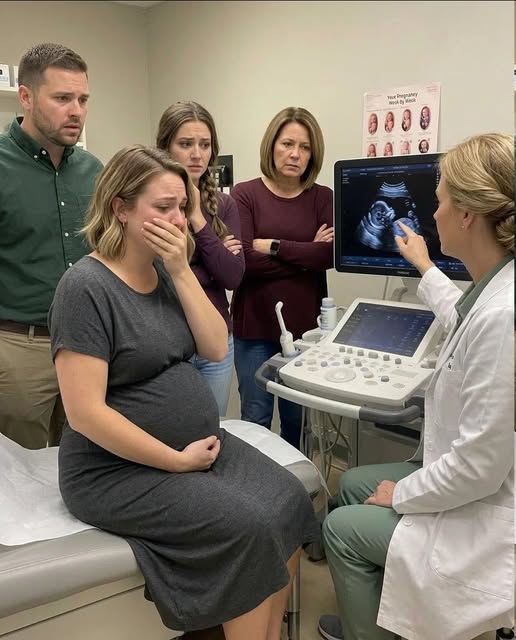
I lay on the examination table while the technician moved the ultrasound probe across my abdomen.
The room was quiet.
Too quiet.
I watched the screen, trying to understand the gray and black shapes appearing in front of me.
Then the technician stopped.
She looked at the screen.
Then at me.
“Did your doctor tell you how far along you should be?”
I gave her the date of my last period.
She frowned slightly.
“What?”
“Your dates may be off.”
My heart started pounding.
“Is something wrong?”
She didn’t answer immediately.
She adjusted the screen.
Then she called the doctor.
A few minutes later, my doctor came into the room.
She examined the ultrasound carefully.
Then she looked at me.
“I want to explain something before you panic.”
My throat tightened.
“What is it?”
She pointed toward the screen.
“There is a pregnancy here.”
I already knew that.
“But there’s something else we need to investigate.”
My stomach dropped.
The Cruelest Shock
The ultrasound wasn’t showing what we had expected.
The pregnancy appeared to be at a different stage than our dates suggested.
The doctor explained that ultrasound dating isn’t always exact, particularly early in pregnancy, but the discrepancy meant they needed additional testing.
Then she said something that made my entire body go cold.
“There is another finding here that we need to evaluate.”
I looked at the screen.
“What kind of finding?”
She didn’t want to speculate before completing the examination.
She recommended additional imaging and blood work.
I left the clinic feeling as though my entire life had been placed on pause.
My husband was waiting outside.
He barely looked at me.
“Well?”
I couldn’t speak.
“What did they say?”
I finally whispered:
“They found something.”
His face changed.
“What?”
“I don’t know yet.”
For the first time since he’d accused me, his anger disappeared.
He looked frightened.
The Truth Was More Complicated Than Either of Us Thought
Over the next several days, we went through more testing.
And eventually, the situation became clearer.
The pregnancy itself wasn’t the shocking impossibility we had imagined.
The vasectomy had never been confirmed as successful.
My husband had never completed the recommended semen analysis.
There had been no medical confirmation that he was sterile.
The doctors explained that vasectomy failure can occur, particularly before sperm clearance has been confirmed. Even after confirmed clearance, pregnancy remains extremely rare rather than absolutely impossible; the CDC cites an estimated risk of about 1 in 2,000 after documented azoospermia.
My husband sat silently in the consultation room.
Then he looked at me.
“I accused you.”
I nodded.
“You didn’t even ask me.”
“I was scared.”
“So was I.”
He lowered his head.
“I thought I knew what had happened.”
“You didn’t.”
“I know.”
For several minutes, neither of us spoke.
Then he reached for my hand.
But the Ultrasound Had Given Us Another Problem
The additional testing showed that the pregnancy needed close monitoring.
The doctor explained that the unusual ultrasound finding did not automatically mean something catastrophic. Sometimes early ultrasound findings look frightening before follow-up imaging provides a clearer answer.
We were told not to jump to conclusions.
And that became the hardest lesson of the entire experience.
A frightening image on a screen is not always a diagnosis.
A pregnancy after vasectomy is not automatically evidence of infidelity.
And a medical procedure is not necessarily successful simply because the procedure itself was performed.
My husband eventually had the semen analysis he’d been avoiding.
The results confirmed what the doctors had warned us about.
He still had sperm present.
The vasectomy had not yet achieved the level of clearance needed to rely on it as contraception.
Suddenly, the pregnancy made sense.
The accusation didn’t.
The Apology
That night, my husband sat beside me.
“I owe you an apology.”
I didn’t answer.
“I should never have accused you.”
“You believed the surgery made pregnancy impossible.”
“I know.”
“And you never went back for the test.”
He nodded.
“I was careless.”
I looked at him.
“You didn’t just make a medical mistake. You made me feel like you didn’t know who I was.”
His eyes filled with tears.
“I know.”
That was the moment I realized something.
Sometimes the cruelest shock isn’t what happens to your body.
It’s discovering how quickly someone you love can doubt your character when fear takes over.
What I Wish We Had Known
If there’s one thing I would tell another couple considering a vasectomy, it is this:
Do not assume the procedure means immediate infertility.
A vasectomy is highly effective, but sperm can remain in the reproductive system for a period of time afterward. That’s why medical guidance recommends another contraceptive method until a semen analysis confirms successful clearance.
The number of ejaculations alone isn’t a reliable way to know whether sperm have disappeared.
Only appropriate follow-up testing can provide that confirmation.
And even after confirmed success, vasectomy isn’t considered 100% fail-proof.
For us, the pregnancy became more than a medical surprise.
It became a test of trust.
My husband had to confront the fact that he had trusted an assumption instead of following up with his doctor.
And I had to confront something even more painful:
How quickly fear can turn love into suspicion.
Months later, when we looked back at that terrifying day in the ultrasound room, we realized something neither of us had understood at the beginning.
The pregnancy wasn’t the impossible part.
The impossible part was believing that one medical procedure could erase every question, every uncertainty, and every responsibility that comes afterward.
Sometimes the truth isn’t the story we fear most.
Sometimes it’s simply the story we failed to check.
Medical Note
A pregnancy after vasectomy can occur, especially before post-vasectomy semen analysis confirms successful sperm clearance. The CDC recommends semen analysis 8–16 weeks after vasectomy and continued contraception until success is confirmed. Anyone facing a suspected pregnancy after vasectomy should discuss the situation with a healthcare professional rather than assuming infidelity or immediately concluding that the procedure failed.
Meta Description
She became pregnant just two months after her husband had a vasectomy, leading to a devastating accusation of infidelity. But the ultrasound revealed a shocking medical twist neither of them expected.
SEO Title
My Husband Had a Vasectomy, Then I Got Pregnant — The Ultrasound Revealed a Shocking Twist
Suggested URL Slug
husband-vasectomy-pregnant-ultrasound-shocking-twist
Focus Keywords
- pregnant after husband’s vasectomy
- pregnancy after vasectomy
- vasectomy failure
- pregnancy two months after vasectomy
- vasectomy and pregnancy
- post vasectomy pregnancy
- vasectomy semen analysis
- shocking ultrasound pregnancy story
- husband accused wife of cheating
- unexpected pregnancy story