Is an upside-down electrical outlet installed incorrectly? Learn why some outlets have the ground hole on top, what the orientation means, and whether it affects electrical safety.
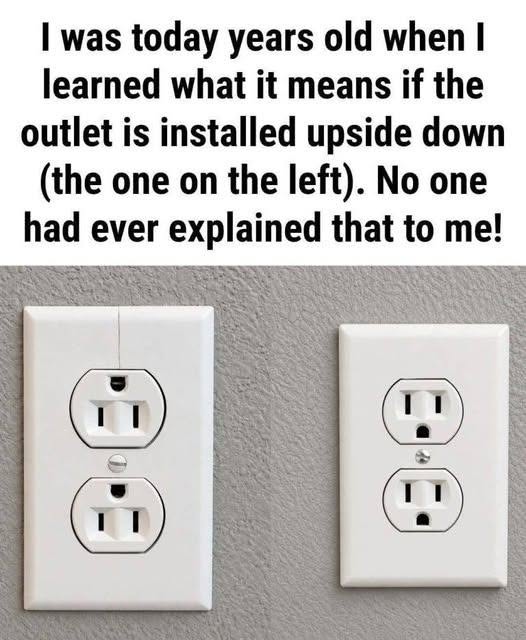
You may have seen the viral image showing two electrical outlets installed in opposite directions, with the caption claiming that one is “upside down.” It certainly makes you look at the outlets in your own home a little differently.
But is one orientation actually wrong?
Not necessarily. The direction of a standard wall receptacle can vary, and seeing the ground hole at the top does not automatically mean an electrician made a mistake.
What Does “Upside Down” Actually Mean?
A typical grounded North American electrical receptacle has two vertical slots and a round opening for the grounding connection.
On a common 120-volt receptacle:
- The smaller vertical slot is generally the hot side.
- The larger vertical slot is the neutral side.
- The round opening is the equipment grounding connection.
The outlet can physically be mounted with the grounding opening facing up or down.
That means an outlet with the round ground opening on top isn’t automatically defective or improperly wired.
Why Do Some Electricians Install the Ground Hole on Top?
There is a safety argument for installing the receptacle with the ground opening on top.
Imagine a plug that is partially pulled out of the wall. The metal prongs may still be connected to the electrical contacts while part of the plug is exposed.
Now imagine a conductive metal object falling onto that partially inserted plug.
With the ground opening on top, the object may contact the grounding portion of the plug first rather than bridging the energized and neutral contacts. This is one reason some electricians and facilities choose the ground-up orientation.
However, this should not be confused with a universal rule that every residential outlet must be installed ground-up.
Does the Ground Hole Being on Top Make an Outlet Safer?
Potentially, in certain situations, the orientation can provide an additional safety advantage.
But the orientation itself is not the main safety feature of the receptacle.
Proper wiring, grounding, circuit protection, GFCI protection where required, and the condition of the receptacle are much more important.
Modern electrical safety standards also address where receptacles can be installed and how they must be protected. For example, the National Electrical Code places restrictions on receptacles installed face-up in certain countertops, work surfaces, seating areas, and areas below sinks because of hazards such as liquid entering the receptacle.
Why Are Many Household Outlets Installed Ground-Side Down?
If you look around homes, offices, hotels, and other buildings, you’ll often see the grounding opening at the bottom.
This orientation has become common because it works well with the way many standard plugs and electrical installations are designed.
An electrician may also follow the established orientation used throughout a particular building.
In other words, consistency is often more important than whether the ground opening is facing up or down.
Is the Outlet in the Viral Image “Wrong”?
The image makes it look as though the outlet on the left has been installed incorrectly.
That’s misleading.
The outlet on the left has the ground opening at the top, while the outlet on the right has it at the bottom. Both orientations can be encountered in real-world electrical installations.
The image therefore shouldn’t be interpreted as proof that one of these outlets is automatically unsafe.
The bigger question is whether the receptacle is correctly installed, properly grounded, appropriately protected, and compliant with the electrical requirements that apply in that location.
What About GFCI Outlets?
GFCI protection is particularly important in locations where people may encounter electricity and water.
GFCI devices are designed to interrupt power when they detect a ground-fault condition, helping protect people from potentially dangerous electric shock. Manufacturers such as Leviton emphasize GFCI protection as an important electrical safety measure.
So if you’re concerned about an outlet in a bathroom, kitchen, garage, outdoor area, laundry area, or another potentially wet location, don’t focus only on whether the ground hole points up or down.
The type of protection and the condition of the installation matter much more.
What About Children?
The orientation of the outlet isn’t a substitute for proper child safety.
For homes with children, tamper-resistant receptacles (TRRs) are specifically designed to prevent objects from being inserted into the electrical contacts unless the internal shutters are activated appropriately. The Electrical Safety Foundation International notes that tamper-resistant receptacles are required in new residential construction under the NEC in applicable jurisdictions.
That’s a much more meaningful safety feature than simply turning the receptacle upside down.
Should You Turn Your Outlets Around?
Don’t automatically change them.
If your outlets are working normally and there is no evidence of damage or an electrical problem, the orientation alone generally isn’t a reason to start removing receptacles.
Electrical work involves energized circuits and can be dangerous. If you’re considering changing receptacles, adding GFCI protection, or checking whether an outlet is properly grounded, it’s safest to have the work evaluated by a qualified electrician.
Also remember that electrical requirements can vary by jurisdiction. The NEC provides minimum requirements in the United States, but local authorities determine how and whether particular editions are adopted and enforced.
Signs an Outlet Actually Needs Attention
Instead of worrying about whether the ground hole is on top or bottom, watch for warning signs such as:
- A receptacle that feels hot to the touch
- Burning or unusual electrical smells
- Sparks or crackling sounds
- Black or brown discoloration
- Loose plugs that fall out easily
- A receptacle that is cracked or physically damaged
- Frequent tripping of a circuit breaker
- Buzzing or sizzling sounds
- Signs of water exposure
- An outlet that doesn’t appear to be properly secured to the wall
These problems deserve attention because they can indicate an electrical fault or damaged equipment.
The Bottom Line
That viral image contains a real electrical-safety idea but presents it too simply.
An outlet with the ground opening on top isn’t necessarily “upside down,” and an outlet with the ground opening on the bottom isn’t necessarily less safe.
Both orientations can be found in legitimate installations.
The important things are proper wiring, grounding, appropriate circuit protection, correct installation, and compliance with the electrical code applicable to your area.
So the next time you see an outlet that looks “upside down,” don’t panic. The direction alone doesn’t tell you whether the outlet was installed correctly.