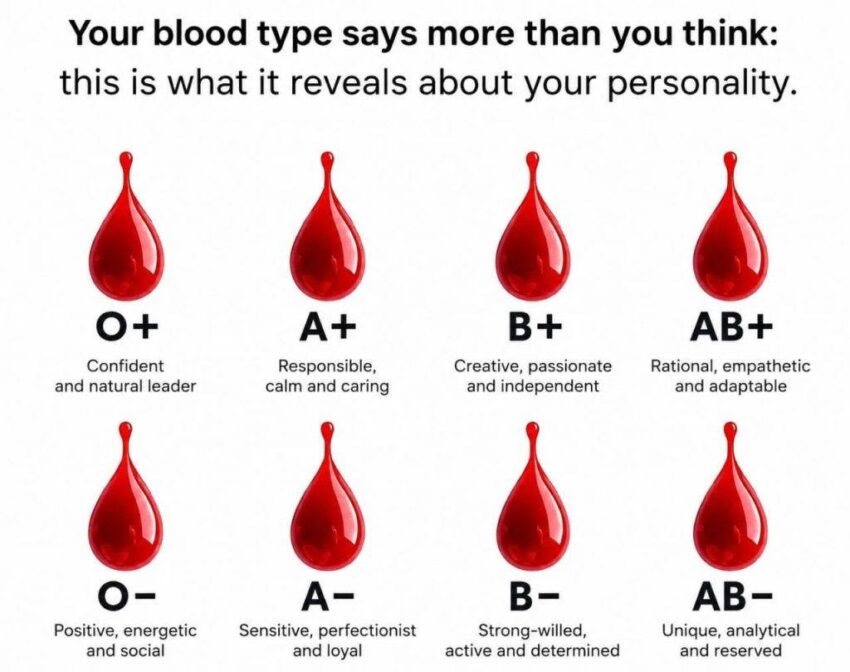
The answer is more complicated than many social-media posts suggest.
What Are Blood Types?
Your blood type is determined by specific molecules, called antigens, found on the surface of your red blood cells.
The best-known blood group system is the ABO system, which divides blood into four major types:
- A
- B
- AB
- O
There is also the Rh system, which is why you may hear someone described as A-positive, O-negative, or another combination.
Blood type is primarily important medically. It matters when doctors determine compatible blood for transfusions and is also relevant in certain pregnancy and medical situations.
But does it determine your personality?
That’s where the science becomes much less certain.
The Popular Blood-Type Personality Theory
The idea that blood type is linked to personality is particularly well known in Japan.
Popular descriptions often assign general characteristics to each blood group.
Type A: Organized and Thoughtful
People with type A blood are sometimes described as:
- Responsible
- Organized
- Careful
- Considerate
- Detail-oriented
- Sensitive
The stereotype often portrays type A personalities as people who like structure and prefer to think things through before acting.
Type B: Independent and Creative
Type B is sometimes associated with people who are:
- Independent
- Creative
- Curious
- Energetic
- Spontaneous
- Strong-willed
The popular image of type B is someone who enjoys freedom and may prefer doing things their own way.
Type AB: Complex and Adaptable
Type AB is sometimes described as a combination of type A and type B characteristics.
According to the popular theory, people with AB blood may be:
- Adaptable
- Calm
- Creative
- Independent
- Thoughtful
- Difficult to categorize
This has contributed to the idea that AB personalities are particularly complex or unpredictable.
Type O: Confident and Outgoing
People with type O blood are often stereotyped as:
- Confident
- Sociable
- Optimistic
- Energetic
- Ambitious
- Natural leaders
The popular stereotype tends to portray type O individuals as outgoing and self-assured.
But there’s an important point to remember.
These descriptions are cultural beliefs, not established personality tests.
What Does Science Actually Say?
There is currently no strong scientific evidence showing that your ABO blood type determines your personality.
Human personality is influenced by a complicated combination of genetics, environment, upbringing, experiences, culture, relationships, and many other factors.
Two people with the same blood type can have completely different personalities.
One person with type A blood might be highly organized and reserved, while another might be spontaneous and outgoing.
Likewise, someone with type O blood may be confident and sociable—or quiet and introverted.
Your blood type simply cannot provide a complete picture of who you are.
Why Does the Theory Feel So Accurate?
One reason blood-type personality descriptions can seem surprisingly convincing is that many of the traits are broad and relatable.
Consider statements such as:
“You care deeply about people but sometimes need time alone.”
Many people could recognize themselves in that description.
This is related to a psychological phenomenon known as the Barnum effect, in which people tend to find vague and generally applicable personality descriptions personally meaningful.
Social expectations can also play a role.
If someone grows up repeatedly hearing that their blood type is associated with a particular personality, they may begin to identify with those characteristics.
In other words, the belief itself can potentially influence how someone thinks about their identity.
Your Blood Type Can Tell Doctors Important Things
Although your blood type may not reveal whether you’re shy, adventurous, organized, or emotional, it absolutely has medical significance.
Blood Transfusions
Blood type is critical when determining compatible blood for transfusion.
Giving incompatible blood can cause a serious immune reaction, which is why blood typing and crossmatching are essential medical procedures.
Pregnancy
The Rh blood group system can also be important during pregnancy.
When an Rh-negative mother carries an Rh-positive fetus, there can be a risk of Rh incompatibility. Modern medical care can identify and manage this situation.
Some Disease Associations
Researchers have also found associations between certain blood groups and the risk of some diseases and medical conditions.
However, an association does not mean that blood type causes the disease or that knowing your blood type can predict your individual future.
Your overall health is influenced by many factors.
Does Blood Type Affect Relationships?
This is one of the most popular questions surrounding blood-type personality theory.
Some people use blood type to discuss romantic compatibility or friendship.
For example, popular culture sometimes claims that certain blood groups are naturally compatible while others may clash.
There isn’t convincing scientific evidence that blood type can predict whether two people will have a successful relationship.
Relationships depend on communication, trust, shared values, emotional compatibility, respect, personality, circumstances, and countless other factors.
Your blood type isn’t a substitute for getting to know someone.
Should You Believe Blood-Type Personality Tests?
There’s nothing wrong with enjoying blood-type personality discussions as entertainment or as a cultural tradition.
The problem begins when these stereotypes are treated as facts.
A blood type shouldn’t be used to judge someone’s intelligence, character, reliability, romantic compatibility, or ability to perform a job.
In fact, assigning personality traits to people based solely on blood type can reinforce stereotypes and cause people to make assumptions before getting to know someone.
What Really Reveals Your Personality?
If you’re genuinely interested in understanding your personality, scientifically developed personality assessments are more useful than blood-type stereotypes.
Researchers have extensively studied personality traits such as:
- Openness to experience
- Conscientiousness
- Extraversion
- Agreeableness
- Emotional stability
Personality is also not completely fixed. While people often have relatively stable tendencies, experiences and circumstances can influence how those tendencies are expressed over time.
Your habits, relationships, environment, values, and life experiences all contribute to the person you become.
So, What Does Your Blood Type Really Reveal?
Your blood type can reveal something important—but probably not what those personality charts claim.
It tells you about a biological characteristic of your blood that can be medically significant.
It does **not reliably tell you whether you’re naturally shy or outgoing, creative or practical, calm or emotional, or destined to have a particular type of relationship.
The personality connection remains an interesting cultural idea rather than an established scientific fact.
The Bottom Line
Your blood type is part of your biology, but it isn’t a personality blueprint.
If you’re type A, B, AB, or O, you don’t have to fit a predetermined personality category. Your character is shaped by a much richer combination of genetics, experiences, environment, relationships, and personal choices.
So the next time someone asks for your blood type and immediately starts describing your personality, enjoy the conversation—but take the personality prediction with a healthy dose of skepticism.
Your blood may have a type. Your personality is much more complicated.