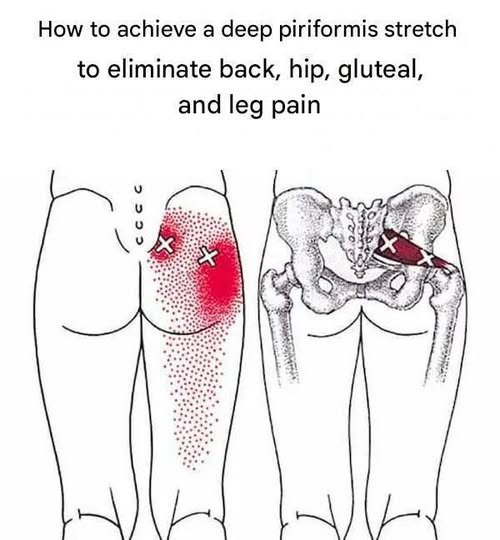
Learn how to safely perform a piriformis stretch for tight hips and glutes, including step-by-step instructions, helpful modifications, and situations where you should see a healthcare professional.
Tightness in the buttock, hip, or back of the leg can sometimes involve the piriformis, a small muscle located deep in the buttock. Stretching it may provide relief for some people—but it is important not to assume that every case of back, hip, or leg pain is caused by the piriformis.
If pain travels down the leg, especially with numbness, tingling, or weakness, the underlying problem could involve a nerve or the lower back and should be evaluated rather than treated with increasingly aggressive stretching.
What Is the Piriformis?
The piriformis is a small muscle deep in the buttock. It helps rotate and stabilize the hip.
Because the sciatic nerve passes near or, in some people, through the piriformis region, irritation around this area can sometimes produce symptoms that extend into the buttock or leg.
A Gentle Figure-4 Piriformis Stretch
One of the simplest ways to stretch the piriformis is the lying figure-four stretch.
Step 1: Lie on Your Back
Lie comfortably on a firm but supportive surface with both knees bent and your feet flat on the floor.
Step 2: Cross One Leg
Place your right ankle over your left thigh, just above the knee. Your legs should form a shape similar to the number 4.
Step 3: Draw the Legs Toward You
Reach behind your left thigh and gently bring the left leg toward your chest.
You should feel a gentle stretch in the right buttock/hip.
Step 4: Hold the Position
Hold the stretch for approximately 20–30 seconds, breathing normally. Don’t bounce or force the movement.
Repeat on the opposite side.
Step 5: Repeat
Try 2–3 gentle repetitions per side, provided the movement feels comfortable.
A Deeper Version
If the basic stretch feels comfortable, you can gradually bring the supporting leg closer to your chest.
However, deeper does not necessarily mean better.
You should feel a controlled stretch—not sharp pain, burning, electric sensations, or increasing numbness/tingling down the leg.
What You Should NOT Do
Avoid aggressively pulling your leg toward your chest or forcing the crossed knee toward the floor.
Stop the stretch if you develop:
- Sharp or severe pain
- Increasing tingling or numbness
- Electric/shooting pain down the leg
- New muscle weakness
- Significant pain that persists after the stretch
Can a Piriformis Stretch Eliminate Sciatica?
Not necessarily.
Although the piriformis can be involved in sciatic-type symptoms, sciatica can have several causes, including problems involving the lumbar spine.
Therefore, a piriformis stretch shouldn’t be promoted as a guaranteed cure for back, hip, gluteal, or leg pain.
For persistent symptoms, a healthcare professional or physical therapist can determine whether the piriformis, spine, hip joint, or another structure is contributing to the problem.
Other Things That May Help
Depending on the cause of your discomfort, a comprehensive approach may include:
- Gentle movement and walking
- Strengthening the hips and glutes
- Gradual mobility exercises
- Avoiding prolonged sitting
- Improving exercise technique
- Physical therapy when appropriate
When Should You Seek Medical Care?
Get medical advice if pain is persistent, worsening, or interfering with normal activities.
Seek urgent medical attention for back or leg pain accompanied by new bowel or bladder control problems, numbness around the groin/saddle area, or significant or rapidly worsening weakness in the legs.
Final Thoughts
A gentle figure-four stretch can be a useful mobility exercise for some people with tightness around the buttock and hip. The goal is comfortable, gradual tension—not maximum intensity.
And if stretching makes your leg pain worse, don’t keep pushing through it. The right treatment depends on what’s actually causing the pain.
Medical disclaimer: This article is for general educational purposes and isn’t a diagnosis or substitute for individualized medical advice.