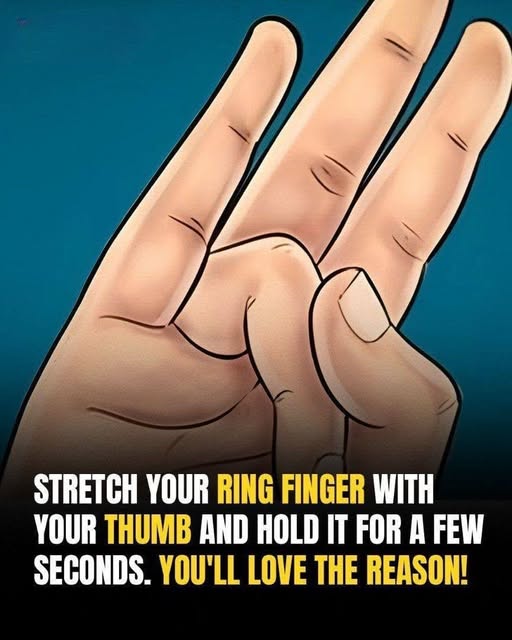
Discover what happens when you gently stretch your ring finger with your thumb and hold the position. Learn about possible relaxation benefits, hand mobility, and what science actually says about this simple exercise.
Stretch Your Ring Finger With Your Thumb and Hold It – Discover the Surprising Benefits
A simple hand exercise has been attracting attention online: gently stretching the ring finger with the thumb and holding the position for a few seconds.
The technique looks almost too easy to matter. Yet gentle finger movements can be useful for maintaining hand mobility, reducing stiffness, and encouraging people to pay attention to tension in their hands.
Some social-media posts make much stronger claims, suggesting that holding specific fingers can influence particular organs or instantly improve certain health conditions. Those claims should be approached carefully because they are not well established by medical research.
Still, there is a reasonable benefit to simple hand stretching when it is performed gently and correctly.
How to Perform the Exercise
You don’t need any equipment.
- Sit comfortably and relax your shoulders.
- Place one hand in front of you with the palm facing upward or inward.
- Use the thumb of your other hand to gently support the ring finger.
- Slowly move the ring finger into a comfortable stretch.
- Hold the stretch for approximately 10–20 seconds.
- Release slowly.
- Repeat on the other hand.
The movement should feel like a mild stretch, not pain.
Never force the finger backward or pull aggressively.
1. It May Help Maintain Finger Flexibility
Our hands perform countless movements every day, from typing and writing to cooking and opening containers.
Gentle range-of-motion exercises can help keep the joints and surrounding tissues moving.
This can be particularly useful for people who spend long periods using keyboards, phones, tools, or other repetitive hand movements.
The exercise isn’t a cure for arthritis or another joint disorder, but regular gentle movement can be part of a general hand-mobility routine.
2. It Can Help You Notice Hand Tension
Many people unconsciously keep their hands tense.
You may notice this while:
- Using a computer
- Driving
- Holding a phone
- Doing detailed work
- Feeling stressed
Slowly stretching one finger at a time encourages you to relax your grip and pay attention to how your hands feel.
That awareness can be useful even if the exercise itself doesn’t have a special medical effect.
3. It May Feel Relaxing
Gentle stretching combined with slow breathing can create a calming routine.
Try inhaling slowly through your nose while preparing the stretch, then exhaling as you gently hold it.
This doesn’t mean the ring finger has a special ability to reduce anxiety. Rather, slow movement and focused breathing can contribute to relaxation.
4. It Supports Gentle Range of Motion
Finger joints are designed to move.
Regular, comfortable movement can help prevent the hands from becoming unnecessarily stiff, especially when you’re not moving them much during the day.
A simple routine might include:
- Opening and closing your hands
- Slowly bending and straightening your fingers
- Touching the thumb to each fingertip
- Gently stretching individual fingers
- Rotating your wrists
These exercises are simple ways to incorporate movement into your day.
5. It May Be Useful After Periods of Repetitive Hand Use
After prolonged typing, gaming, writing, crafting, or other repetitive activities, your hands may feel tired or stiff.
A brief mobility routine can give you an opportunity to stop, relax your grip, and move the fingers through a comfortable range.
However, persistent pain should not simply be stretched away.
If hand pain continues or worsens, it’s worth discussing it with a healthcare professional.
Does the Ring Finger Have a Special Connection to Your Organs?
This is where many online claims become misleading.
You may see posts claiming that holding or stretching a particular finger can directly affect the heart, liver, kidneys, lungs, or other organs.
There is not good scientific evidence that stretching the ring finger has a direct therapeutic effect on a specific internal organ.
Some traditional healing systems associate different fingers with different body systems. These traditions can be culturally interesting, but their proposed organ connections should not be confused with established medical anatomy or physiology.
The ring finger is connected to the nervous system and musculoskeletal structures of the hand, but that does not mean stretching it can directly “detox” an organ or cure disease.
What About Acupressure and Traditional Practices?
Certain traditional practices use pressure or stimulation at specific points on the hands and body.
People may report feeling relaxed or experiencing temporary symptom relief after such practices.
However, the mechanisms proposed by traditional systems are not always supported by modern scientific evidence.
If you enjoy gentle hand exercises or traditional practices, they can be incorporated into a relaxation routine—but they should not replace appropriate medical treatment.
When Should You Avoid the Exercise?
Gentle stretching is generally different from forceful stretching.
Stop immediately if you experience:
- Sharp pain
- Numbness
- Tingling
- Significant swelling
- A popping sensation
- Loss of movement
- Increasing pain
If you’ve recently injured your finger, hand, or wrist, don’t begin stretching exercises without appropriate guidance.
People with significant arthritis, tendon injuries, fractures, recent surgery, or persistent unexplained hand symptoms may need an individualized exercise plan.
A Simple 2-Minute Hand Routine
You can combine the ring-finger stretch with several other gentle movements.
Step 1: Open and Close
Slowly open your hand and then make a relaxed fist.
Repeat 5–10 times.
Step 2: Thumb-to-Fingertip Touch
Touch your thumb to your index finger, middle finger, ring finger, and little finger one at a time.
Repeat several times.
Step 3: Ring-Finger Stretch
Gently support the ring finger with your opposite thumb and stretch it comfortably for 10–20 seconds.
Repeat on the other hand.
Step 4: Wrist Movement
Slowly move your wrists through a comfortable range of motion.
Don’t force the movement.
Step 5: Relax
Shake your hands gently and let your fingers relax.
Take a few slow breaths.
The Important Difference Between a Stretch and a Treatment
This simple distinction can prevent a lot of health misinformation.
A hand stretch may help with mobility, awareness of tension, and relaxation.
That doesn’t mean it can treat an underlying disease.
For example, someone with persistent numbness in their fingers could have nerve compression, diabetes-related nerve problems, an injury, or another medical issue. Stretching alone wouldn’t identify or treat the underlying cause.
Likewise, severe joint pain shouldn’t automatically be attributed to “stiffness.”
Final Takeaway
Stretching your ring finger gently with your thumb and holding the position can be a simple addition to a hand-mobility or relaxation routine.
Its realistic potential benefits include:
- Supporting comfortable finger movement
- Maintaining flexibility
- Encouraging relaxation
- Helping you become more aware of hand tension
- Giving your hands a brief break from repetitive activities
But claims that this specific finger stretch can cure diseases, detox the body, or directly heal internal organs are not supported by strong scientific evidence.
Keep the movement gentle, never stretch through pain, and seek medical advice for persistent or worsening hand symptoms.
Sometimes the simplest exercises are useful—not because they have mysterious powers, but because regular, gentle movement is good for keeping the body moving