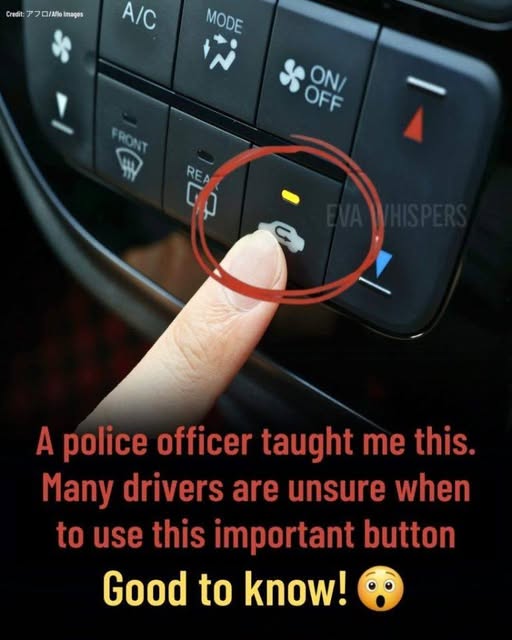
That small button on your car’s dashboard may control an important feature. Learn what common dashboard buttons do, why drivers often overlook them, and when using them can improve comfort, visibility, and safety.
Modern cars have more buttons, symbols, and controls than ever before. Some are used every day, while others may go untouched for years.
One button that many drivers overlook is the air recirculation button. It is usually represented by a symbol showing a car with a curved arrow traveling inside the cabin.
But what exactly does it do—and when should you use it?
What Does the Air Recirculation Button Do?
When you press the air recirculation button, your vehicle generally stops drawing as much air from outside and instead recirculates air already inside the cabin.
This can be particularly useful when outside air is unpleasant or polluted.
For example, you might use it when:
- Driving behind a smoky vehicle
- Passing through an area with unpleasant odors
- Sitting in heavy traffic
- Driving through dusty surroundings
- Trying to cool the cabin more quickly on a hot day
Why Does It Help Cool the Car?
On a hot day, continuously bringing hot outside air into the vehicle makes the air-conditioning system work harder.
Recirculating the cooler cabin air can help the system cool the interior more efficiently.
That’s one reason you may notice the cabin becoming comfortable faster when the recirculation setting is switched on.
But You Shouldn’t Leave It On All the Time
Although recirculation is useful, it isn’t necessarily the best setting for every situation.
When the same cabin air keeps circulating, humidity and carbon dioxide can build up, particularly when several people are inside the vehicle.
You may eventually notice:
- Fogging windows
- A stuffier cabin
- Increased humidity
- Reduced freshness of the air
Switching to fresh-air mode periodically can help bring outside air into the cabin.
What About Foggy Windows?
This is where many drivers get confused.
If your windshield or windows are fogging up, recirculation may sometimes make the problem worse because moisture from the occupants’ breath remains inside the vehicle.
Using the defrost/defog setting and fresh outside air can help clear the glass more effectively.
Good visibility is essential, so don’t continue driving with significantly obstructed windows.
What Happens in a Traffic Jam?
Recirculation can be particularly convenient when you’re stuck behind buses, trucks, or vehicles producing exhaust.
It can reduce the amount of unpleasant outside air entering the cabin. However, vehicle ventilation systems and filters vary, and recirculation should not be treated as a substitute for proper ventilation or a guarantee against harmful pollutants.
Another Button Drivers Sometimes Ignore: Traction Control
Depending on the vehicle, another frequently misunderstood dashboard control is the traction-control button.
It may display a symbol resembling a car with wavy lines underneath.
Normally, traction control is designed to help prevent excessive wheel spin during acceleration.
Drivers generally shouldn’t switch it off during ordinary driving unless the vehicle manufacturer specifically recommends doing so for a particular situation.
Why You Should Learn Your Dashboard
A dashboard button may look insignificant simply because you’ve never needed it.
But understanding your vehicle’s controls can help you respond appropriately to changing conditions such as:
- Extreme heat
- Fogged windows
- Heavy traffic
- Dusty roads
- Slippery surfaces
- Poor visibility
The exact symbols and functions vary between makes, models, and model years, so your owner’s manual is the best source for identifying an unfamiliar button.
Final Takeaway
That little dashboard button you’ve ignored may have a practical purpose.
The air-recirculation control can be useful for cooling the cabin and reducing unpleasant outside odors, while fresh-air and defrost settings are important when ventilation or clear windows are needed.
Instead of guessing what an unfamiliar button does, take a moment to check your vehicle’s manual. Knowing these controls before an emergency or difficult driving condition occurs can make driving more comfortable—and potentially safer.
Always follow your vehicle manufacturer’s instructions for the specific controls and features in your car.