Have you ever wondered why some people seem slightly intimidated by you—even when you’re not trying to scare anyone?
Sometimes, it isn’t about what you say. It can be the way you carry yourself, your confidence, your facial expressions, or simply the energy people associate with you.
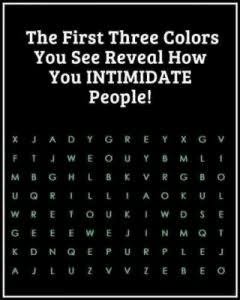
This fun visual personality test takes a different approach: look at the image and notice the first three colors that catch your attention. According to the personality interpretation behind this test, those colors may offer clues about the impression you tend to make on other people.
This isn’t a psychological diagnosis or a scientifically validated personality test. Think of it as a playful way to reflect on how you might come across to others.
How to Take the Test
Don’t overthink it.
Look at the color image for a few seconds and identify the first three colors that naturally grab your attention.
Write them down in the order you noticed them.
Your first color represents the strongest impression you may give people. The second can suggest another quality people notice, while the third may reveal a quieter part of your personality.
Now let’s see what your colors might say.
Red — You Can Seem Powerful
If red is one of the first colors you notice, you may naturally give off a strong and confident impression.
People might see you as passionate, direct, determined, or difficult to push around.
You may not actually be aggressive, but your confidence can sometimes make people think twice before challenging you.
Why can this feel intimidating?
Because you’re unlikely to appear easily influenced. When you know what you want, you may communicate it clearly—and that certainty can be powerful.
Black — You Have a Mysterious Presence
Black can represent mystery, seriousness, authority, and emotional restraint.
If you notice black quickly, people may sometimes have difficulty figuring out what you’re thinking.
You might not be the person who tells everyone everything about yourself. That privacy can create an intriguing but intimidating presence.
People may wonder:
“What is this person really thinking?”
Your quietness may sometimes speak louder than words.
Blue — You Seem Calm and Self-Controlled
Blue is often associated with calmness, stability, and trust.
If blue immediately catches your attention, you may appear composed even when things around you become stressful.
That can be intimidating in an unexpected way.
Someone who remains calm while everyone else is losing control can appear extremely confident.
People may assume that you’re difficult to shake or manipulate.
Green — You Seem Independent
Green is commonly associated with nature, balance, growth, and independence.
If green is among your first three colors, you may give people the impression that you’re comfortable doing things your own way.
You don’t necessarily need constant approval from others.
That independence can be attractive—but it can also make insecure people uncomfortable.
Yellow — Your Energy Stands Out
Yellow is bright, energetic, and attention-grabbing.
If yellow is one of the first colors you see, you may have a noticeable personality.
People might describe you as expressive, cheerful, energetic, or mentally quick.
Your enthusiasm can sometimes overwhelm quieter personalities.
You may walk into a room without intending to attract attention, yet people notice you anyway.
Purple — You Have an Unusual Quality
Purple is often connected with creativity, imagination, individuality, and mystery.
If purple catches your eye early, you may come across as someone who doesn’t fit neatly into ordinary categories.
You may have your own opinions, interests, or way of looking at things.
That originality can be intimidating because people can’t always predict what you’ll do next.
Orange — You’re Bold and Social
Orange tends to stand out.
If you notice orange quickly, you may appear energetic, confident, spontaneous, and socially comfortable.
You may be the kind of person who starts conversations easily and isn’t afraid of being noticed.
For someone who is shy or reserved, that confidence can feel intimidating—even when you’re simply being friendly.
Pink — You May Be More Emotionally Powerful Than You Realize
Pink is often associated with warmth, affection, sensitivity, and emotional expression.
If pink is among your first three colors, people may initially see you as approachable and kind.
But there may be another side to this.
Emotionally perceptive people can notice changes in other people’s moods quickly. If you tend to understand what others are feeling without them saying much, that ability can make some people feel exposed.
White — You Give a Clean, Controlled Impression
White can suggest simplicity, clarity, openness, and order.
If white is one of the first colors you notice, you may appear organized and composed.
People may feel that you have clear standards about how you want things done.
Your calm appearance can sometimes be mistaken for being difficult to impress.
What If Your Three Colors Are Very Different?
That’s where this test becomes especially interesting.
For example, someone who notices red, blue, and green might interpret the combination as confidence, composure, and independence.
Someone who notices yellow, orange, and pink might come across as highly expressive, energetic, and socially engaging.
Meanwhile, black, purple, and blue could create an impression of someone mysterious, thoughtful, and difficult to read.
The combination can sometimes tell a more interesting story than any single color.
The Real Reason People May Feel Intimidated
Ultimately, the colors you notice aren’t capable of proving how other people perceive you.
What actually influences whether someone finds you intimidating is much more complicated.
Your posture, voice, eye contact, confidence, boundaries, facial expressions, social behavior, and even the way you respond to disagreement can all affect someone’s impression of you.
And sometimes, people aren’t intimidated by you at all—they’re simply unsure how to approach you.
Final Thought
So, what were the first three colors you noticed?
Take a moment to think about them.
Do their descriptions feel surprisingly accurate, or do you think your personality is completely different?
Remember, this is a fun personality exercise rather than a scientific assessment. The most interesting part isn’t whether the test is “right”—it’s whether the description makes you think differently about the impression you give other people.