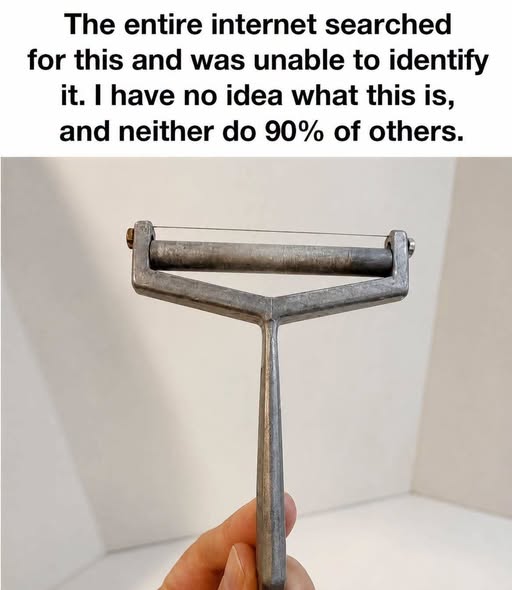
A strange vintage kitchen gadget left everyone guessing until its real purpose was discovered. Learn how forgotten kitchen tools were used and why these old utensils are fascinating pieces of culinary history.
There was a time when almost every kitchen had a specialized tool for a job that today might be handled by a food processor, electric mixer, or another modern appliance.
That is why vintage kitchen drawers can contain some truly mysterious objects.
One oddly shaped utensil recently became the subject of a familiar internet question: “What on earth is this thing?”
At first glance, it looked more like a miniature mechanical device than something that belonged in a kitchen. There was no obvious explanation for its unusual shape, and people offered guesses ranging from a strange peeler to a specialized cutting tool.
But once its construction and moving parts were examined more closely, the mystery finally began to make sense.
The Clues Were Hiding in Plain Sight
Vintage kitchen tools are often easier to identify when you start with the part that actually touches the food.
A blade usually indicates cutting or slicing. Perforations suggest draining, grating, or pressing. A crank and gears often point toward a mechanical food-processing task.
Materials can also provide clues.
Wooden handles, cast metal bodies, Bakelite components, and early stainless-steel construction can help narrow down when a utensil was made. Patent dates and maker’s marks can provide even stronger clues, although a patent date doesn’t necessarily tell you the exact year a particular item was manufactured.
So What Was the Mystery Tool?
In cases like this, one particularly common source of confusion is the vintage food mill.
Older food mills can look surprisingly complicated. Many feature a bowl-like container, a hand crank, a perforated disk, and a curved blade or scraping mechanism.
Their purpose was actually quite practical: to turn cooked foods into a smooth purée while separating out skins, seeds, or fibers.
Tomatoes, apples, potatoes, and other cooked fruits and vegetables could be processed this way.
Instead of plugging in a modern appliance, the cook simply turned the handle.
Why Did People Need a Tool Like This?
Imagine preparing tomato sauce before modern electric kitchen appliances were commonplace.
You could cook the tomatoes until soft and then push them through a food mill. As the crank turned, the internal mechanism forced the softened food through small holes.
The result was a smoother purée while larger pieces such as skins and seeds remained behind.
For families who preserved large quantities of garden produce, this could be an extremely useful tool.
Other Vintage Kitchen Gadgets That Confuse People
The food mill isn’t the only forgotten utensil that can leave modern cooks scratching their heads.
Bean Frencher
This unusual mechanical gadget was designed to slice green beans lengthwise into thin strips. Its crank-and-blade construction can make it look like a workshop tool rather than a kitchen utensil.
Cherry Pitter
Older cherry pitters came in several designs, including spring-loaded versions and larger mechanical models. Their purpose was to remove the stone from cherries without crushing the entire fruit.
Nutmeg Grater
Small vintage nutmeg graters can resemble tiny metal containers or decorative objects. Some were designed with storage compartments for whole nutmeg.
Rotary Egg Beater
Before electric mixers became standard, hand-cranked egg beaters were a common way to whip eggs, cream, and other ingredients.
Pie Crimper
Another fascinating example is the vintage pie trimmer and sealer. One documented example had a Bakelite handle and a small wheel designed to crimp and seal the edge of pie dough.
Why These Tools Look So Strange Today
The biggest reason is simple: the jobs they performed have changed—or the tools have disappeared.
A modern cook might use a blender to purée tomatoes, a food processor to chop vegetables, or an electric mixer to beat eggs.
Earlier generations often accomplished the same tasks with specialized hand-operated gadgets.
That means the object itself may look completely unfamiliar even though its function was once obvious to the people who used it every week.
How to Identify Your Own Mystery Kitchen Tool
If you discover a strange utensil in an old drawer, don’t throw it away immediately.
Start by examining the working end.
Ask:
- Does it have blades?
- Are there holes or perforations?
- Does anything rotate?
- Is there a crank or spring?
- Does it clamp onto something?
- Is there a maker’s name?
- Is there a patent number or date?
- What materials were used?
Photographs from several angles can also make identification much easier. A clear image of the entire tool, its working end, and any markings can provide important clues.
Some Are More Valuable Than They Look
A mysterious old kitchen utensil isn’t necessarily valuable simply because it’s old.
Collectors generally care about factors such as maker, rarity, condition, unusual design, completeness, and provenance.
Common vintage utensils may be worth relatively little, while unusual patented gadgets, desirable cast-iron pieces, complete sets, or items from sought-after manufacturers can command considerably more.
And if you think you’ve discovered something valuable, avoid aggressively cleaning it before identifying it. Original finishes and patina can sometimes be important to collectors.
The Fascinating Part Isn’t Always the Value
Perhaps the most interesting thing about vintage kitchen tools isn’t how much they’re worth.
It’s what they tell us about everyday life.
A small hand-cranked gadget can reveal how people prepared food before electricity and modern appliances transformed the kitchen. What looks like a useless piece of metal today may once have saved someone hours of work.
That’s why the next time you find a strange utensil at an estate sale, thrift store, or tucked away in your grandmother’s kitchen drawer, don’t dismiss it just because you don’t recognize it.
It may have a story—and a surprisingly practical purpose—waiting to be rediscovered.