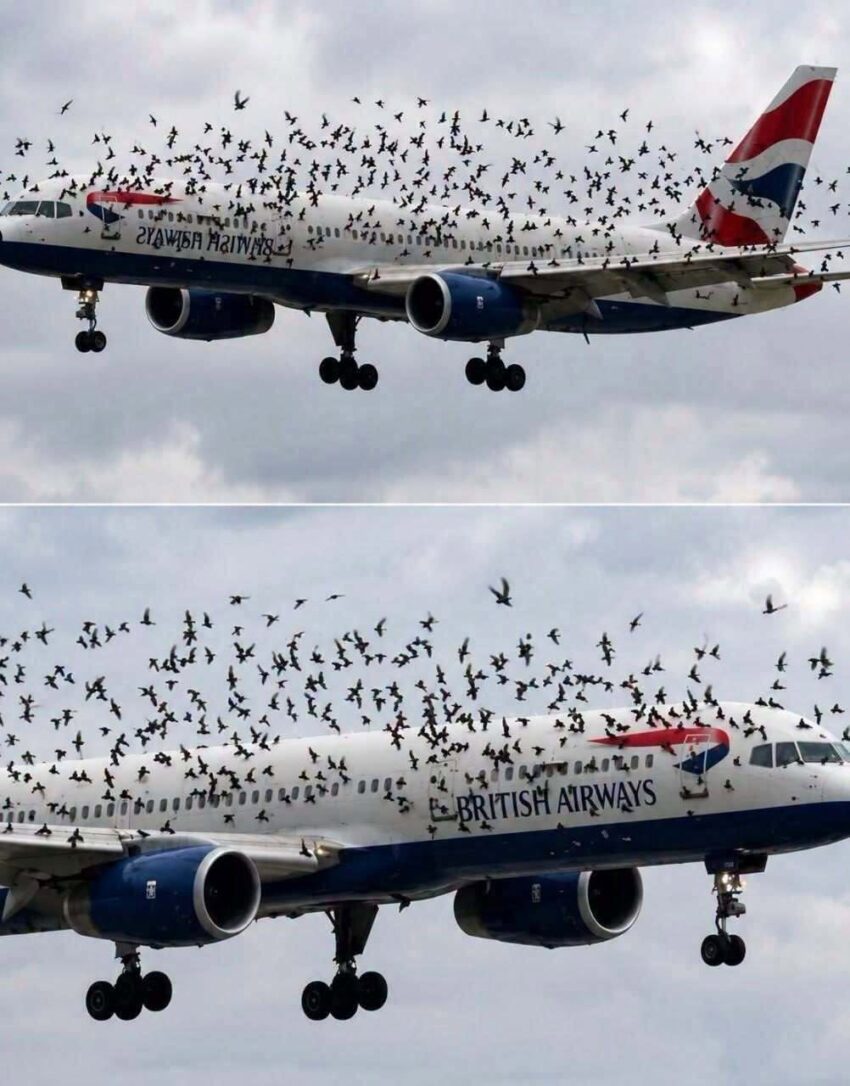
A pilot begins noticing birds following his aircraft wherever he flies. At first, he dismisses it as a strange coincidence, but when he discovers the heartbreaking reason behind their behavior, he breaks down in tears.
The first time Captain Daniel Hayes noticed the birds, he thought he was simply tired.
He had been flying for nearly four hours, crossing a stretch of countryside beneath a pale morning sky, when a small group of birds appeared beside his aircraft. They moved effortlessly through the air, keeping their distance from the wings.
Daniel had seen birds during countless flights. It was nothing unusual.
But something about these birds was different.
They didn’t disappear after a few seconds. They stayed nearby, occasionally moving away before returning again.
When Daniel landed, he mentioned the incident to a colleague, who laughed and told him he probably needed a vacation.
Daniel laughed, too.
He had no idea that the birds would soon become part of a mystery that would change his life.
The Birds That Kept Returning
Over the following weeks, Daniel began noticing the same strange occurrence on different flights.
Whenever he flew over a particular region, birds seemed to appear near his aircraft. Sometimes there were only two or three. Other times, there were dozens scattered across the sky.
He initially assumed they were different birds following similar flight paths.
But the pattern became difficult to ignore.
One afternoon, while preparing for another routine flight, Daniel noticed a small bird sitting on a fence near the hangar. As he approached, it flew away.
Minutes later, after takeoff, several birds appeared in the distance.
He shook his head and concentrated on his instruments.
Pilots couldn’t afford to become distracted by coincidences.
Still, the experience unsettled him.
Daniel had spent most of his adult life in the air. He loved the freedom of flying, the changing colors of the horizon, and the peaceful silence that settled over the cockpit during long stretches of stable flight.
Yet he had also spent years avoiding a part of his past.
A part he rarely discussed.
A Memory He Had Tried to Forget
Twenty-three years earlier, Daniel had been a young pilot just beginning his career.
He was ambitious, confident, and eager to prove himself. His father, Thomas, had been the person who encouraged him most.
Thomas wasn’t a pilot. He was a quiet man who worked with his hands, repaired broken things, and spent much of his free time caring for the birds around his small countryside home.
He had a particular affection for injured birds.
Whenever he found one unable to fly, he would bring it inside, treat its wounds, and keep it safe until it could return to the wild.
Daniel used to tease him about it.
“Why do you spend so much time helping creatures that will fly away the moment they’re better?” he once asked.
His father smiled.
“Because helping someone shouldn’t depend on whether they stay.”
Daniel remembered those words, but at the time, he hadn’t understood them.
Then came the accident.
During a training flight, Daniel experienced an emergency that forced him to make a difficult landing. He survived, but the incident changed his life. His father had been traveling to see him when he received the news.
Thomas never made it to the hospital.
A road accident took his life that same afternoon.
Daniel recovered physically, but grief followed him for years. He stopped visiting his father’s home. He avoided conversations about the past and buried himself in work.
The countryside where his father had lived eventually became just another stretch of land beneath his aircraft.
Or so he believed.
The Flight That Changed Everything
One autumn morning, Daniel was assigned a routine flight across the region where he had grown up.
The weather was clear, and the aircraft performed normally.
Then he saw them again.
Birds.
A small group appeared off to the side, moving across the sky.
Daniel watched them briefly, then returned his attention to flying.
A few minutes later, more appeared.
By the time he approached the area surrounding his childhood home, he could see several birds circling in the distance.
Something inside him tightened.
He recognized the landscape below: the winding road, the narrow river, and the patchwork of fields that surrounded his father’s old property.
He hadn’t visited in years.
After landing safely, Daniel contacted an old family friend who still lived nearby.
During their conversation, he mentioned the birds.
There was a long silence.
Then the friend asked, “Have you been flying over your father’s land?”
Daniel felt his stomach tighten.
“I think so. Why?”
His friend hesitated before answering.
“Because the birds are still there, Daniel. People in the village have been looking after them for years.”
Daniel frowned.
“What do you mean, looking after them?”
“They remember your father,” the friend replied. “Or, at least, they still gather around the place where he used to care for them.”
Daniel didn’t know what to say.
His friend continued, explaining that Thomas had once cared for injured birds in a small shelter beside his home. After his death, local residents had kept the shelter going for a time.
Some birds returned regularly to the property. Others nested in nearby trees.
Over the years, the shelter had changed, and many of the people who remembered Thomas had grown older. But the birds continued to gather around the familiar grounds.
Daniel felt something shift inside him.
For the first time, he wondered whether the birds he had been seeing were connected to the place he had spent so long avoiding.
He needed to see it for himself.
The Discovery at His Father’s House
The following weekend, Daniel drove to the countryside.
The journey felt longer than he remembered. Every familiar turn brought back memories he had spent years trying to suppress.
When he finally reached the property, he stopped beside the old gate.
The house looked smaller than it had in his childhood.
The garden was overgrown, and the paint had faded. But near the back of the property, he could still see the wooden shelter his father had built for injured birds.
Daniel walked toward it slowly.
Inside were old feeding trays, a few weathered containers, and a small wooden box filled with handwritten notes.
His father’s handwriting.
Daniel picked up the notes with trembling hands.
They contained simple observations: which birds had been injured, what they had eaten, and when they had recovered enough to fly.
One entry described a young bird that had arrived with a damaged wing.
Another recorded the return of a bird released months earlier.
At the bottom of one page, his father had written:
“Some may never remember who helped them. That doesn’t make the help any less worthwhile.”
Daniel sat down.
He read the sentence again.
And again.
For years, he had believed that grief meant losing everything connected to the person who had died.
But here, in a quiet shelter surrounded by weeds and old wood, he was discovering something else.
His father’s kindness had left traces in the world long after he was gone.
Why the Birds Wouldn’t Leave Him Alone
As Daniel stepped outside, he heard a fluttering sound above him.
Several birds had settled in the branches of a nearby tree.
Another landed on the roof of the old shelter.
He stood very still.
He couldn’t know whether these were the same individual birds his father had cared for, or whether their behavior had anything to do with recognizing Daniel or his aircraft.
Birds gather around familiar habitats for many ordinary reasons: food, shelter, nesting sites, and learned patterns of behavior.
But that scientific explanation didn’t make the moment less meaningful to him.
The birds had brought him back to a place he had abandoned.
They had led him, indirectly, to memories he had been afraid to face.
Daniel remembered his father’s words.
“Helping someone shouldn’t depend on whether they stay.”
Suddenly, he understood why the sentence had stayed with him for so long.
His father had spent his life giving care without demanding anything in return. And Daniel, in his grief, had convinced himself that moving forward meant leaving every painful memory behind.
But perhaps he didn’t need to forget his father to keep living.
Perhaps remembering him could become a source of strength rather than pain.
Daniel looked at the birds in the tree.
His eyes filled with tears.
For the first time in twenty-three years, he allowed himself to cry for his father without trying to stop.
A Promise He Finally Kept
Before leaving the property, Daniel called his father’s old friend and asked whether the shelter could be repaired.
The friend was surprised.
“You want to restore it?”
Daniel nodded, although nobody could see him.
“I think Dad would have wanted that.”
Over the following months, Daniel helped repair the shelter, replace the damaged feeding stations, and arrange for local volunteers to care for injured birds.
He didn’t try to turn the place into a grand memorial. He wanted it to remain what his father had intended: a quiet refuge where vulnerable creatures could recover.
He also began visiting the countryside more often.
Sometimes he sat beneath the trees without speaking. Sometimes he read his father’s old notes. And sometimes he simply watched the birds moving across the sky.
He never discovered a magical explanation for why they had seemed to follow his aircraft.
He didn’t need one.
Their presence had reminded him of something he had forgotten: love can leave a lasting influence through ordinary acts of kindness.
Years later, when someone asked Daniel why he had devoted so much time to restoring the shelter, he smiled.
“My father spent his life helping birds find their way back into the sky,” he said. “I suppose I finally understood what he was trying to teach me.”
The Lesson Behind the Story
Sometimes, the smallest encounters bring us back to the memories we most need to face.
The birds in Daniel’s story were not proof of a supernatural connection or evidence that animals can recognize the relatives of people who once cared for them. Their behavior may have had entirely natural explanations.
But the meaning Daniel found in the experience was real to him.
He learned that grief doesn’t have to disappear before we can begin to heal. We can carry the love of someone we’ve lost into the choices we make, the people we help, and the kindness we offer to the world.
And sometimes, the most powerful way to honor someone who is gone is to continue the good work they left behind.
Because love is not always remembered through words. Sometimes, it survives through the lives we touch and the kindness we choose to continue.