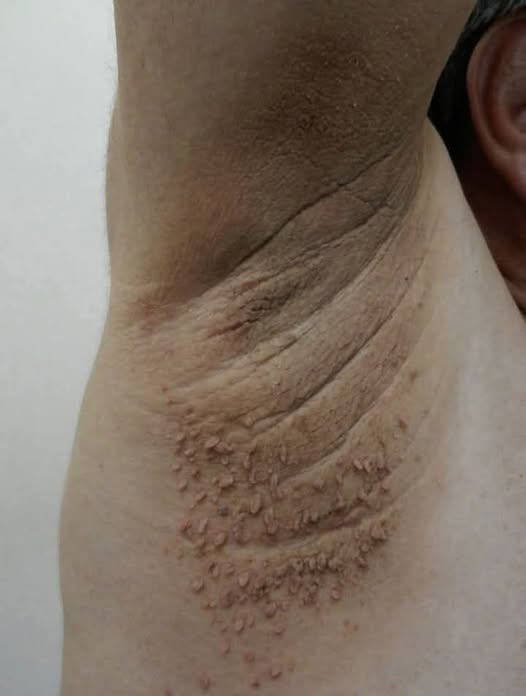
These clustered bumps in the armpit may look concerning, but they can have several causes. Learn what skin tags, warts, and other skin growths look like and when they should be checked by a doctor.
The unusual-looking bumps in this image may immediately make you wonder whether they are a sign of a serious illness. Because they are clustered in the armpit, it is important to look at the possibilities carefully rather than assuming that they represent one particular disease.
A photograph alone cannot provide a definite diagnosis. The bumps could represent skin tags or another type of benign skin growth, but a healthcare professional would need to examine them in person to determine exactly what they are.
What Could These Bumps Be?
One possibility is skin tags, medically known as acrochordons.
Skin tags are soft, usually harmless growths that commonly develop in areas where skin rubs against skin or clothing. Common locations include:
- Armpits
- Neck
- Groin
- Under the breasts
- Eyelids
- Other skin folds
They can be flesh-colored, slightly darker than the surrounding skin, or brownish. Some are attached by a small stalk, while others can appear broader at the base.
Multiple skin tags can sometimes develop in the same area.
Why Do Skin Tags Develop?
The exact reason an individual skin tag develops isn’t always clear, but friction appears to play a role.
They are also more frequently seen in people with certain metabolic risk factors, including overweight and insulin resistance.
This does not mean that everyone with skin tags has diabetes or another metabolic condition.
If someone suddenly develops numerous new skin tags, particularly alongside other health concerns, it can be reasonable to discuss the changes with a healthcare professional.
Could They Be Warts?
Another possibility is warts.
Warts are caused by certain types of human papillomavirus (HPV) and often have a firmer or rougher surface than typical skin tags.
Their appearance can vary considerably depending on their location and type.
Because some skin lesions can look similar to one another, attempting to identify them solely from an online photograph can be misleading.
Are These Bumps a Sign of Cancer?
It is important not to jump to that conclusion.
Most skin tags are benign and are not cancerous. The presence of bumps in an armpit does not, by itself, indicate cancer.
However, any skin growth that is rapidly changing, repeatedly bleeding, painful, ulcerated, or otherwise unusual should be examined by a healthcare professional.
A doctor may be able to identify a typical skin tag simply by examining it. If a lesion looks unusual, additional testing may sometimes be recommended.
What About Diabetes?
Skin tags can occur more frequently in people with insulin resistance and type 2 diabetes.
For that reason, a person with numerous skin tags may want to discuss general metabolic health with their healthcare professional, particularly if they also have risk factors for diabetes.
Possible screening may include a blood glucose test or HbA1c, depending on the person’s age, risk factors, and medical history.
But skin tags are not a diagnostic test for diabetes.
You should not conclude that you have diabetes simply because you have skin tags.
When Should You Have the Bumps Checked?
Make an appointment with a doctor or dermatologist if the growths:
- Appear suddenly in large numbers
- Grow rapidly
- Change color or shape
- Bleed without obvious injury
- Become painful
- Develop an ulcer or open sore
- Become persistently irritated
- Look substantially different from your other skin growths
- Keep returning after being removed
An examination is particularly worthwhile when you’re unsure whether the growths are actually skin tags.
Don’t Cut Them Off at Home
If these are skin tags, it can be tempting to cut, burn, tie, or freeze them yourself.
That can cause bleeding, infection, scarring, and skin damage. Some products marketed online for removing skin tags may also be inappropriate for certain lesions.
A healthcare professional can determine what the growth is and, if removal is appropriate, choose a suitable method.
What If the Area Itches or Hurts?
Armpit skin is exposed to considerable friction and moisture. Deodorants, shaving, tight clothing, and sweating can also irritate the area.
Try to keep the area clean and dry and avoid repeatedly scratching or rubbing the growths.
If there is significant redness, warmth, swelling, pus, or increasing pain, medical evaluation is advisable because these symptoms can indicate inflammation or infection.
A Note About “First Symptoms” Headlines
Headlines claiming that a particular skin growth is the “first symptom” of cancer or another major disease should be treated cautiously.
There is usually no single skin lesion that can reliably diagnose a serious condition without an examination and appropriate testing.
The bumps shown in the photograph should not be used as proof of cancer, Crohn’s disease, diabetes, or any other specific condition.
The correct approach is to identify the lesion first and then consider whether any underlying health issue needs evaluation.
The Bottom Line
The clustered bumps shown in the image could be skin tags or another type of benign skin growth, but an image cannot establish the diagnosis.
Skin tags are common in the armpits and other areas where skin rubs together. They are generally harmless, although numerous skin tags can sometimes occur alongside metabolic risk factors.
If the growths are new, rapidly changing, bleeding, painful, or simply look unusual, arrange an examination with a dermatologist or other qualified healthcare professional.
Don’t panic—and don’t try to remove them yourself before you know what they are.