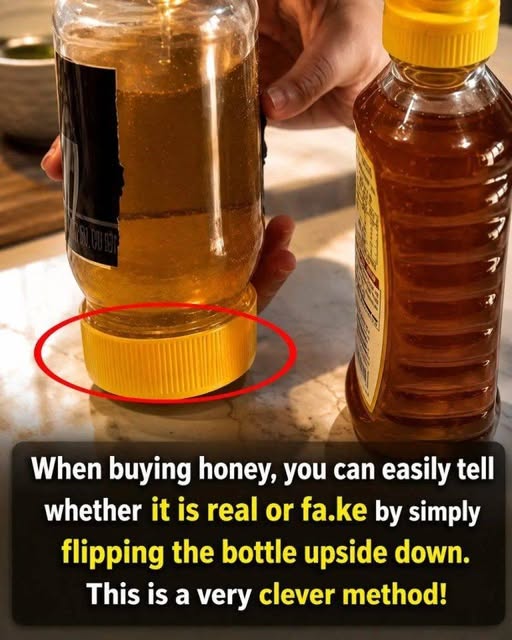
Think your honey is pure? Learn what “real honey” means, what labels to check, and which popular home tests can be misleading when trying to identify adulterated honey.
Honey is often treated as a simple, natural food, but choosing a quality jar isn’t always straightforward. Terms such as “pure,” “natural,” and “raw” can sound reassuring, yet they don’t necessarily tell you everything about how the product was produced or whether it has been blended with other sweeteners.
If you’re trying to buy genuine honey, there are a few practical things you can check.
1. Read the Ingredient List
Start with the simplest step: look at the ingredients.
If you’re buying a product sold as honey, honey should be the only ingredient listed. If the label identifies added syrups, flavorings, or other sweeteners, it isn’t simply honey.
Don’t rely solely on the front of the package. Turn the jar around and read the complete label.
2. Don’t Assume “Raw” Means Pure
“Raw honey” generally refers to honey that hasn’t undergone the same degree of processing or heating as some commercial honey products.
However, raw doesn’t automatically mean more authentic.
A product can be minimally processed while still requiring you to consider where it came from, how it was labeled, and whether the producer is reputable.
3. Be Careful With Viral Honey Tests
You’ve probably seen internet tricks claiming that you can test honey by:
- Dropping it into water
- Lighting it with a match
- Putting it on your thumb
- Checking whether it crystallizes
- Watching how quickly it dissolves
These tests are not reliable ways to prove that honey is pure.
For example, crystallization is completely normal in many genuine honeys, and the speed at which honey dissolves can depend on factors such as moisture content and temperature.
A home experiment can’t reliably identify every form of adulteration.
4. Crystallized Honey Isn’t Automatically Fake
Some people throw away honey as soon as it becomes cloudy or develops crystals.
That’s unnecessary.
Many genuine honeys naturally crystallize over time. The rate and texture can vary depending on the floral source and storage conditions.
If you prefer liquid honey, placing the container in warm water can gradually soften the crystals. Avoid excessive heat, particularly if preserving the characteristics associated with minimally processed honey is important to you.
5. Consider the Source
Buying from a reputable beekeeper, cooperative, or established food producer can make it easier to learn where the honey came from.
Look for useful information such as:
- Producer or company name
- Country or region of origin
- Batch or lot information
- Proper food labeling
- Clear contact information
A transparent producer should be able to tell you where their honey comes from.
6. Price Isn’t Proof
Very cheap honey may make you suspicious, but price alone cannot prove whether honey is genuine.
Likewise, an expensive jar isn’t automatically pure.
Use the price as one piece of information, not as a laboratory test.
7. Professional Testing Is the Real Answer
When honey authenticity is important—particularly for commercial buyers—laboratory analysis is far more reliable than kitchen tricks.
Sophisticated testing can examine characteristics of honey and detect certain forms of adulteration that can’t be identified simply by looking, tasting, or performing a viral social-media experiment.
One More Important Reminder
Honey is still a form of added sugar from a dietary perspective. Even genuine honey should be enjoyed in reasonable amounts.
And never give honey to babies under 12 months old, because of the risk of infant botulism.
Bottom Line
There isn’t a magic two-minute kitchen test that can guarantee a jar of honey is genuine.
Instead, read the label, check the source, buy from reputable producers, and don’t mistake normal crystallization for evidence of fake honey. When certainty is essential, professional laboratory testing is the dependable option.