Looking for an easy way to remove weeds from patios and walkways? Learn which household methods can kill visible weeds quickly, why milk is not a proven weed killer, and how to prevent weeds from returning.
This Simple Weed-Killing Remedy Can Help Remove Weeds in Just One Day
Weeds growing between patio stones, paving slabs, and cracks in walkways can make an otherwise clean outdoor space look neglected. Fortunately, you don’t always need complicated equipment to deal with small areas of unwanted weeds.
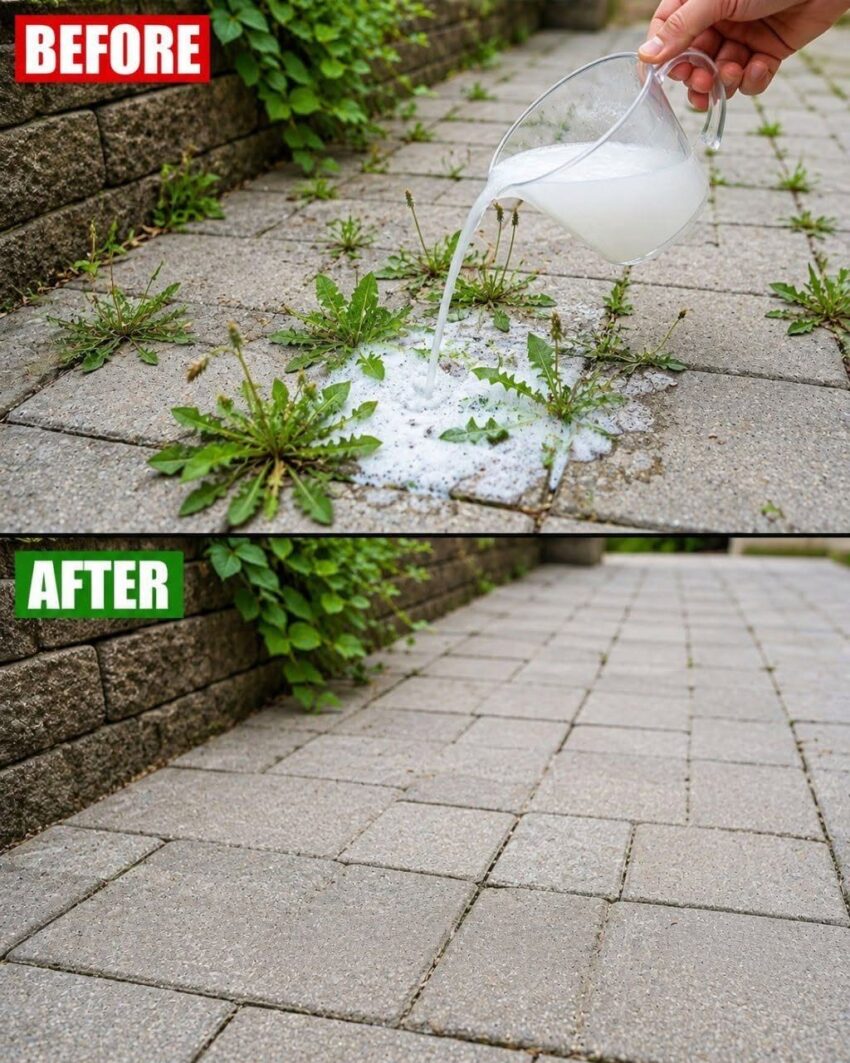
A popular online gardening image shows someone pouring a white liquid over weeds and suggests that the weeds can disappear within a day. However, the white liquid shown appears to be milk, and milk is not a scientifically established weed killer. It may coat the leaves temporarily, but there is no reliable evidence that ordinary milk will kill established weeds in one day.
The Quickest Simple Method: Boiling Water
For weeds growing between paving stones, one of the simplest household methods is carefully applied boiling water.
Very hot water can damage the leaves and tissues of small weeds. It is particularly useful for weeds growing in cracks where you don’t want other plants nearby.
How to use it
- Bring water to a boil.
- Carefully carry it to the area containing the weeds.
- Slowly pour the hot water directly over the unwanted plants.
- Try to wet the leaves and the area around the base.
- Allow the area to cool before walking across it.
- Check the weeds over the following several days.
- Remove dead plant material and any remaining roots where practical.
For young, shallow-rooted weeds, you may see significant wilting relatively quickly. One application does not guarantee complete eradication, particularly when weeds have deep or established roots.
Why Boiling Water Works
Plants rely on living cells in their leaves and stems. Extremely hot water can damage those cells, causing the plant tissue to wilt and die.
The advantage is that boiling water does not leave a long-lasting herbicidal residue.
However, it is not selective. If boiling water reaches grass, flowers, desirable plants, or other vegetation, they can also be damaged.
It can also damage or discolor some surfaces, so test an inconspicuous area if you are concerned about your paving material.
What About the Milk Shown in the Picture?
Milk is sometimes promoted online as a natural solution for weeds.
While milk contains proteins, fats, sugars, and minerals, it should not be considered a dependable herbicide.
Pouring milk onto weeds can also create unpleasant odors as it spoils and may attract insects or other unwanted pests. For that reason, using milk as a routine weed-control method is not recommended.
If you’ve seen a viral post claiming that milk “burns” weeds in 24 hours, treat the claim with caution.
Another Option: Physical Weed Removal
For a small patio or walkway, physically removing the weeds can be surprisingly effective.
Use a hand weeder, narrow garden tool, or paving-joint scraper to loosen the plant and remove as much of the root as possible.
This method takes more effort than pouring a liquid over the weeds, but it has an important advantage: you are removing the plant rather than simply damaging its leaves.
Deep-rooted weeds may return if portions of the root remain.
What About Vinegar?
Household vinegar is another commonly mentioned DIY weed-control method.
Acetic acid can damage plant foliage, particularly on young weeds. However, ordinary household vinegar is not necessarily a reliable solution for eliminating established perennial weeds.
It is also non-selective, meaning it can damage desirable plants if it contacts them.
Repeatedly applying vinegar to soil can also affect soil organisms and vegetation around the treated area.
If you choose to use a commercial herbicide instead, follow the product label carefully and use only products that are legally permitted and appropriate for the location and plants you are treating.
Why Weeds Keep Coming Back
Killing the visible leaves doesn’t always solve the underlying problem.
Weeds can return because:
- Roots remain underground.
- Seeds are already present in cracks.
- Wind carries new seeds into the area.
- Soil and organic debris accumulate between paving stones.
- Water collects in small gaps.
- The area receives enough sunlight for new growth.
That’s why prevention is just as important as removing existing weeds.
How to Stop Weeds From Returning
After removing the weeds, clean out the cracks between paving stones.
Sweep away soil, leaves, and other organic debris that can provide a growing medium for new plants.
Keeping joints clean and repairing damaged or wide gaps can also make it harder for weeds to become established.
For larger areas, consider appropriate jointing materials or professional advice about maintaining the paving surface.
A Simple Routine for a Cleaner Patio
You can maintain a weed-free-looking walkway with a simple routine:
Step 1: Remove visible weeds.
Step 2: Remove as much of the root as practical.
Step 3: Clear soil and debris from cracks.
Step 4: Treat new small weeds promptly using an appropriate method.
Step 5: Sweep the area regularly.
Step 6: Inspect the paving every few weeks, especially during periods of active plant growth.
Regular maintenance is usually easier than allowing weeds to become large and deeply rooted.
Important Safety Tips
If you use boiling water, be extremely careful. Hot water can cause serious burns.
Never carry or pour boiling water around children or pets, and make sure you have stable footing.
If you use any commercial weed-control product, read and follow the label instructions. Wear any protective equipment specified on the label, keep children and pets away as directed, and avoid spraying when wind could carry the product onto desirable plants.
Avoid mixing household chemicals together. Combining cleaning products or other substances can produce dangerous fumes or reactions.
Final Thoughts
The viral image showing milk being poured over weeds may look convincing, but milk is not a proven one-day weed killer.
For a small number of weeds growing between paving stones, carefully applied boiling water or physical removal can be a much more practical approach. For persistent or extensive weed growth, a suitable labeled weed-control product may be an option when used exactly according to its instructions.
The best long-term strategy is to remove weeds early, clean the spaces between paving stones, and prevent soil and debris from accumulating.
Remember: a quick weed-control method may damage the visible plant, but removing the root and preventing new growth is what helps keep your patio looking clean for longer.
Safety Disclaimer: This article provides general gardening information. Always consider the surface being treated, nearby plants, pets, children, and local regulations before using any weed-control method. Follow product labels whenever commercial herbicides are used.