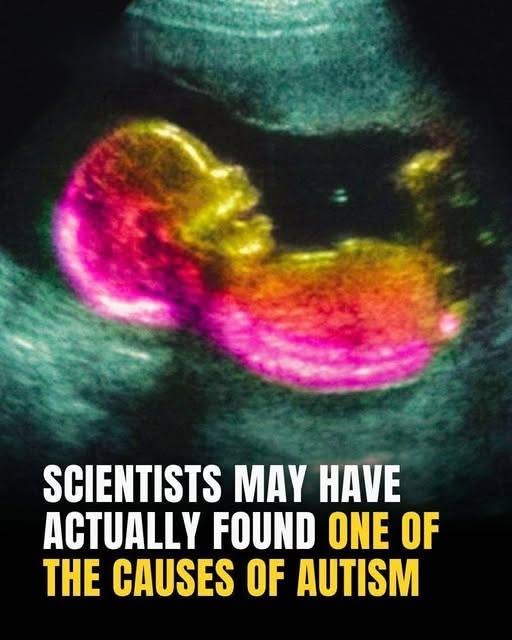
A viral image claims scientists have discovered one of the causes of autism. Learn what research actually shows about autism, genetics, pregnancy factors, brain development, and why there is no single known cause.
A colorful ultrasound image with the headline “Scientists may have actually found one of the causes of autism” can certainly grab attention. But the claim needs some important context.
The truth is much more complicated: autism does not have one single known cause. Autism spectrum disorder (ASD) is a neurodevelopmental condition associated with differences in how the brain develops and functions. Research indicates that many genetic and environmental factors can contribute to autism, and different combinations may be involved in different people.
🧠 Autism Isn’t Caused by One Thing
Scientists have spent decades studying why some children develop autism. Evidence points strongly toward genetics, but genes aren’t the entire story.
Researchers have identified numerous genetic variations associated with increased likelihood of autism. Some are inherited from parents, while others can occur spontaneously during development.
At the same time, certain factors related to pregnancy and early development have been associated with a higher likelihood of autism. Importantly, an association does not necessarily mean that a particular factor directly causes autism.
This distinction is especially important when reading sensational social-media headlines.
🔬 What About the Finding Shown in the Image?
The picture appears to be an ultrasound-style image of a developing fetus, but an ultrasound image by itself cannot show that a fetus will develop autism.
Autism cannot currently be diagnosed before birth through a routine ultrasound.
Researchers can study fetal brain development and other biological processes, and some research investigates whether prenatal biological differences might eventually help us understand autism better. But that is very different from saying that doctors can look at an ultrasound and identify autism.
🧬 Genetics Play a Major Role
One of the strongest areas of autism research involves genetics.
Autism tends to run in families, and studies involving twins and families have demonstrated a substantial genetic contribution.
However, saying autism is “genetic” does not mean there is one autism gene.
Instead, researchers have found that hundreds of genetic differences may influence neurodevelopment. Some individual genetic conditions are also associated with a substantially higher likelihood of autism.
This helps explain why autism can look very different from one person to another.
🌱 What About Pregnancy and Environmental Factors?
Scientists have investigated numerous prenatal and early-life factors, including certain infections, medications, complications of pregnancy and birth, and other biological influences.
Some have been associated with an increased probability of autism, but researchers have to be extremely careful when interpreting these findings.
For example, if two things occur together more frequently, that doesn’t automatically prove that one caused the other.
There can also be confounding factors—another underlying factor may influence both.
💊 Vaccines Do NOT Cause Autism
One of the most persistent autism myths is that childhood vaccines cause autism.
Extensive research has found no credible evidence that routine childhood vaccines cause autism.
The original claim that sparked much of this controversy was based on fraudulent and seriously flawed research and has been retracted.
So a headline suggesting that scientists have discovered a prenatal “cause” of autism should not be interpreted as evidence supporting vaccine-related claims.
👶 Autism Begins During Brain Development
Autism is understood as a neurodevelopmental condition. This means that differences in brain development begin early in life.
Scientists are studying processes such as:
- How neurons develop
- How brain cells communicate
- How different brain regions connect
- How genes influence brain development
- How prenatal biological factors affect development
- Why autism characteristics vary so widely
This research may eventually lead to better ways of understanding autism and providing support.
⚠️ Be Careful With “Scientists Found the Cause” Headlines
A research study can discover an association, identify a biological mechanism, or uncover a risk factor without discovering “the cause.”
Those are very different claims.
A more scientifically accurate headline would be:
“Researchers may have identified a factor that could contribute to autism risk.”
That’s much less dramatic—but much closer to how scientific evidence actually works.
The Bottom Line
The viral claim that scientists have found “one of the causes of autism” is too simplistic.
Autism is believed to result from a complex interaction of genetic and developmental factors, rather than one single cause. Research is progressing rapidly, and individual discoveries may help scientists understand how autism develops, but no single prenatal ultrasound finding currently provides a definitive explanation or diagnosis.
And most importantly, parents should never blame themselves if their child is autistic. Autism is not caused by poor parenting, and there is no evidence that a parent simply “did something wrong” that caused it.
Science is still investigating the many biological pathways involved in autism—and understanding those pathways is far more useful than searching for one simple cause.