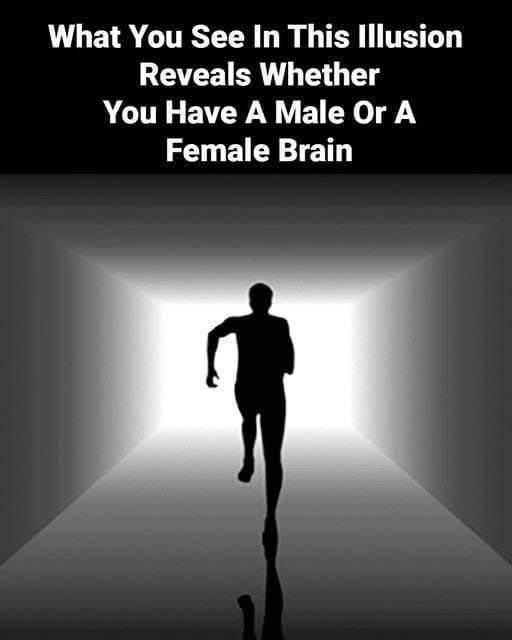
At first glance, this optical illusion looks like a simple picture of a man running. But take another look. Is the man actually running toward you, or is he moving away from you?
The fascinating part is that your brain may interpret the same image differently from someone else’s. Some people immediately see a person running toward them, while others are convinced that the figure is running in the opposite direction.
So, which one do you see?
Why Can the Same Image Look Different?
Optical illusions demonstrate how the brain interprets visual information rather than simply recording everything the eyes see.
When you look at an ambiguous image, your brain searches for familiar patterns and uses clues such as body position, shadows, perspective, depth, and the apparent direction of movement. When those clues can support more than one interpretation, your brain may choose one version and then suddenly switch to another.
This is why an image can appear to change even though nothing about the picture has actually changed.
Is the Man Running Toward You?
If you see the man’s body moving in your direction, your brain may be interpreting certain parts of his posture as evidence that he is approaching the viewer.
The position of the legs and arms can create a strong impression of forward movement. Perspective can also make the figure appear closer, giving the illusion that he is running directly toward you.
Once your brain settles on this interpretation, the image may seem completely obvious.
Or Is He Running Away?
Now try looking at the same figure differently.
You may suddenly notice details that make it appear as though the man is moving away from you. His body position, the angle of his legs, and the apparent depth of the scene can all be interpreted differently.
This is the key feature of an ambiguous optical illusion: your brain can reorganize the same visual information and arrive at a different conclusion.
Why Does Your Brain Switch Directions?
Your visual system is constantly making predictions.
When an image doesn’t provide enough information to determine depth or movement with certainty, your brain fills in the missing details. It may initially choose one interpretation based on the strongest visual cues.
After you stare at the picture for a while, another interpretation may become more convincing.
This phenomenon is sometimes called perceptual switching. The image itself remains unchanged, but your perception changes.
Does Your Answer Reveal Something About You?
These illusions are often accompanied by claims that your answer reveals your personality, intelligence, age, or way of thinking.
Those claims should be treated cautiously.
Seeing the man running toward you rather than away from you does not, by itself, provide a reliable psychological test or diagnosis. Your interpretation is much more likely to depend on the visual cues in the image, your viewing angle, attention, and how your brain resolves the ambiguity.
A Simple Test
Look at the image for several seconds without looking away.
First decide which direction you see.
Then try to deliberately reverse your interpretation. Focus on the legs, body position, and apparent depth of the scene.
Can you make the man appear to change direction?
If you can, you’ve experienced the main trick behind the illusion: your perception has changed while the actual image has remained exactly the same.
Why Optical Illusions Are So Fascinating
Optical illusions give us a glimpse into how complicated human vision really is.
We often assume that seeing means simply looking at what is in front of us. In reality, the brain is constantly processing information, making assumptions, comparing patterns, and constructing an interpretation of what we see.
An ambiguous running figure is a simple example of this process. Two people can look at the same image and confidently describe completely different movements.
And sometimes, one person can see both interpretations at different moments.
So, What Do You See?
Take one more look at the figure.
Is the man:
Running toward you?
Or:
Running away from you?
There is no need to rush your answer. Look carefully and see whether your perception changes when you focus on different parts of the image.
Then share your answer with others and compare what they see. You may be surprised to discover that people looking at exactly the same picture can experience completely different interpretations.
Which direction do you see: toward you or away from you?