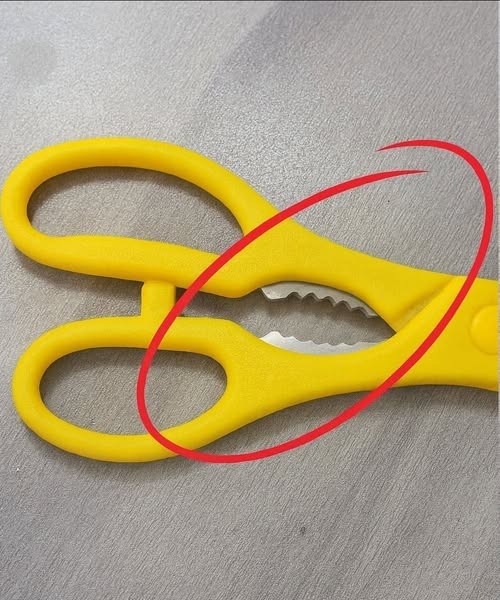
Have you ever looked closely at a pair of kitchen scissors and wondered what the strange toothed or serrated section between the handles is actually for?
It may look like a small, unnecessary detail, but on many kitchen shears, those teeth are there for a reason. In fact, this little section can turn an ordinary pair of scissors into a surprisingly useful multi-purpose kitchen tool.
The Toothed Section Is Designed to Grip
The teeth are primarily designed to provide a firm grip on objects that are difficult to hold with smooth surfaces.
When you place something between the toothed sections and squeeze the handles, the teeth help prevent the object from slipping. This is particularly useful for small, hard, or rounded items.
Depending on the design of your kitchen scissors, this section may have several different functions.
1. Cracking Nuts
One of the most common uses is cracking nuts.
Some kitchen shears are designed with a small nutcracker area between the handles. The teeth hold the nut securely while the handles provide leverage.
You may be able to use it for nuts such as:
- Walnuts
- Pecans
- Hazelnuts
- Almonds with suitable shells
- Other small shelled nuts
However, not every pair of kitchen scissors is strong enough for heavy-duty nut cracking, so it’s best to check the manufacturer’s design before putting excessive pressure on the handles.
2. Opening Bottle Caps
Some kitchen scissors incorporate a bottle-cap opener into the handle area.
The textured or toothed section can grip the edge of a cap and provide additional leverage, making it easier to loosen.
This is one reason kitchen shears can sometimes look more complicated than ordinary household scissors—they are often designed to perform several kitchen tasks.
3. Holding Slippery Items
Another important function is simply gripping.
Smooth objects can be difficult to hold, particularly when your hands or the item are wet or greasy. The serrated teeth provide extra traction.
Depending on the scissors, this can be useful for holding or gripping things such as:
- Small food packages
- Tough stems
- Small bones or joints
- Slippery ingredients
- Other small kitchen objects
The exact purpose varies considerably between manufacturers and models.
4. Why Are the Teeth Serrated?
The serrations aren’t there to cut food. They work more like tiny gripping points.
A smooth metal surface can allow a rounded object to slide out when pressure is applied. The teeth create multiple contact points, helping keep the object in place.
Think of the difference between trying to hold a slippery jar with a smooth surface versus using a textured rubber grip. Texture creates traction.
5. Kitchen Scissors Are More Than Just Scissors
Good kitchen shears are often designed as a multi-function tool.
Besides cutting herbs, meat, packaging, poultry, and other foods, some models may include:
- Nutcracker sections
- Bottle openers
- Jar-opening grips
- Serrated gripping areas
- Herb-stripping features
- Bone-cutting capabilities
- Screw-cap or lid-gripping sections
That’s why the handles of kitchen scissors can sometimes look surprisingly complicated.
Don’t Assume Every Toothed Section Has the Same Purpose
This is important.
Not every pair of kitchen scissors uses its toothed section for exactly the same thing. Some are specifically designed as nutcrackers, while others are intended mainly for gripping.
The shape, size, location, and construction of the teeth can reveal what the manufacturer intended them to do.
If the section is positioned directly between the handles and forms a small enclosed gripping area, it is often intended for cracking or gripping. If it has a specially shaped notch, it may have another function such as opening caps.
A Simple Way to Test Its Function
If you’re unsure what the toothed part on your scissors does, don’t immediately try it on something extremely hard.
First, examine the scissors closely. Look for:
- A small circular or oval gripping area.
- Matching teeth on both sides.
- A notch designed to catch an object.
- Labels or markings from the manufacturer.
- Instructions that came with the scissors.
Avoid forcing the handles together on very hard objects because excessive pressure can damage the hinge, bend the handles, or cause the scissors to become misaligned.
The Bottom Line
That mysterious toothed section on kitchen scissors is usually a gripping and multi-purpose feature, and on many models it can function as a nutcracker or bottle-cap opener.
So the next time you see those little teeth, don’t assume they’re decorative. They were often deliberately included to make your kitchen shears much more versatile.
One small section can perform a surprisingly useful job—and it may save you from reaching for another kitchen tool.
Meta Description
What is the strange toothed part on kitchen scissors for? Discover how this clever feature can help grip objects, crack nuts, open bottle caps, and make kitchen shears more versatile.