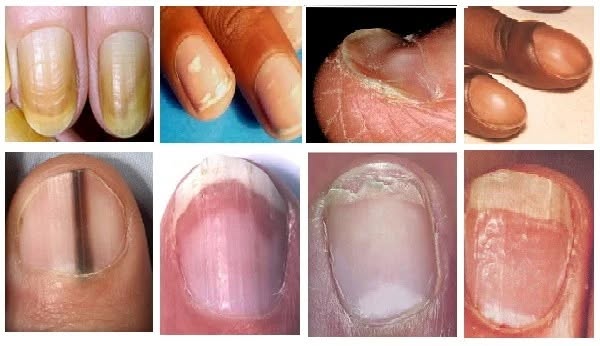
Changes in nail color, shape, texture, or growth are often harmless, but some can be clues to infections, nutritional deficiencies, skin conditions, or other health problems. Learn which nail changes deserve attention.
Your fingernails and toenails can sometimes provide useful clues about what is happening in your body. A change in nail color, texture, thickness, or shape may result from something as simple as an injury, frequent exposure to water, or nail polish. However, certain persistent or unusual changes can also be associated with conditions such as fungal infections, psoriasis, iron-deficiency anemia, thyroid disease, diabetes, or heart and lung problems.
Importantly, a nail abnormality does not automatically mean you have a particular disease. A proper examination is often needed to determine the cause.
1. Spoon-Shaped Nails
Nails that become unusually thin and curve inward in the center are called koilonychia, or spoon nails.
One possible cause is iron deficiency, including iron-deficiency anemia. Other causes are also possible, so persistent spoon-shaped nails should be evaluated rather than treated with iron supplements without confirmation.
2. Small Pits or Dents
Tiny dents that look as though someone pressed an icepick into the nail are known as nail pitting.
They can occur with skin conditions such as:
- Psoriasis
- Atopic dermatitis
- Alopecia areata
If pitting appears suddenly or affects several nails, a dermatologist can help determine the underlying cause.
3. Deep Horizontal Grooves
Deep grooves running across the nail are called Beau’s lines.
They can appear when nail growth is temporarily interrupted or slowed. Fever, significant illness, injury, chemotherapy, and major physical stress are among the possible triggers.
Because nails grow slowly, a groove may represent something that happened weeks or months earlier.
4. Yellow, Thickened Nails
Yellow nails can have relatively simple explanations, including nail polish staining or smoking. But yellow, thickened nails that grow poorly can sometimes be associated with fungal infection or, less commonly, certain systemic conditions.
Fungal infections commonly cause nails to become discolored, thickened, brittle, lifted, or misshapen.
5. Nails That Lift Away From the Skin
When a nail separates from its nail bed, it is called onycholysis.
Possible causes include:
- Fungal infection
- Psoriasis
- Trauma
- Aggressive manicures
- Repeated irritation
A nail that repeatedly lifts without an obvious injury should be examined to determine the cause.
6. Curved Nails and Enlarged Fingertips
When the nails become increasingly curved and the fingertips become rounded or swollen, this may be clubbing.
Clubbing can sometimes be associated with diseases affecting the lungs, heart, liver, or digestive system, although some people naturally have a familial form of curved nails.
New or progressive clubbing deserves medical evaluation.
7. Pale Nails
Nails that become noticeably pale can sometimes occur with anemia or other medical conditions.
However, nail color alone cannot diagnose anemia. If pale nails occur along with symptoms such as persistent fatigue, weakness, headaches, or shortness of breath, discussing the symptoms with a healthcare professional may be appropriate.
8. White Nails
White areas or whitening of the nails have many possible causes. Sometimes they’re related to minor trauma or normal variation; other patterns can be associated with medical conditions.
The important point is that “white nails = liver disease” is too simplistic. Nail appearance needs to be considered alongside your medical history and other symptoms.
9. Blue or Dusky Nails
A blue or bluish nail color can sometimes indicate reduced oxygen in the bloodstream, although cold temperatures and other factors can also temporarily alter nail color.
If nails or fingertips suddenly become blue, particularly when accompanied by difficulty breathing, chest discomfort, confusion, or severe weakness, urgent medical attention is appropriate.
10. A New Dark Streak
A new brown or black streak running lengthwise through a nail should not automatically be dismissed as a bruise.
Although many dark nail streaks are harmless, melanoma can develop under or around a fingernail or toenail. Dermatologists recommend having a new or changing dark streak examined, particularly when it is persistent or changing.
Watch for changes such as:
- A widening dark band
- Irregular pigmentation
- Darkening of the surrounding skin
- Nail splitting
- A bump beneath the nail
- The nail lifting from the nail bed
These findings don’t prove melanoma, but they warrant professional evaluation.
11. Redness and Swelling Around the Nail
Painful, red, swollen skin around a nail can indicate paronychia, an infection or inflammation around the nail.
Bacterial or fungal infections can affect the nail and surrounding skin, particularly when the skin has been damaged through biting, picking, manicures, or other trauma.
12. Brittle, Splitting, or Peeling Nails
Brittle nails are extremely common and don’t necessarily indicate a serious health problem.
Frequent exposure to water, cleaning products, chemicals, nail treatments, or physical trauma can weaken nails. Aging can also make nails more brittle.
Protecting your hands during cleaning and regularly moisturizing the nails and surrounding skin can help reduce damage.
When Should You See a Doctor?
Consider getting a nail change checked if:
- A nail suddenly changes color or shape without an obvious explanation.
- A dark streak is new or changing.
- Several nails develop unusual changes at the same time.
- A nail becomes detached without an injury.
- The skin around the nail becomes painful, red, swollen, or warm.
- Your nails become markedly curved or clubbed.
- Nail changes persist or continue to worsen.
The American Academy of Dermatology recommends professional evaluation for several significant nail changes because appearance alone cannot reliably identify the underlying cause.
Final Takeaway
Your nails can sometimes provide clues—not diagnoses—about your health. Spoon-shaped nails may be associated with iron deficiency, pitting can occur with psoriasis and other conditions, horizontal grooves can follow significant illness or stress, and new dark streaks may require evaluation for melanoma.
At the same time, many nail abnormalities are caused by injury, nail products, moisture, aging, or fungal infections rather than a serious internal disease.
The safest approach is to pay attention to new, persistent, or progressively worsening changes instead of trying to diagnose a condition from nail appearance alone.