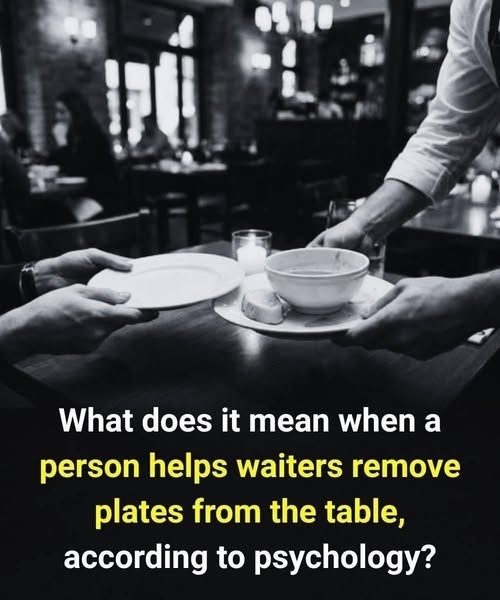
What does it mean when someone helps a waiter clear the table? Explore the psychology behind this small gesture and what it may suggest about empathy, consideration, social awareness, and personality.
It may seem like a tiny gesture: someone finishes eating, notices the plates piling up, and starts helping the waiter clear the table.
But small social behaviors can sometimes reveal interesting aspects of a person’s character. While one action cannot accurately determine someone’s personality, voluntarily helping a server may reflect several positive social tendencies.
1. They May Be Highly Considerate
Someone who helps clear a table may naturally notice when another person is busy or struggling.
Instead of thinking, “That’s the waiter’s job,” they may think, “I can make this a little easier.”
That tendency can reflect consideration for other people’s time and effort.
2. They Notice Things Other People Miss
Some people are simply more observant of their surroundings.
They may notice that the waiter is carrying several plates, that there isn’t enough space on the table, or that dishes need to be moved before new food arrives.
This kind of awareness can be associated with social attentiveness—the ability to notice what is happening around you and respond appropriately.
3. It Can Reflect Empathy
Helping someone without being asked can be a small expression of empathy.
The person may imagine what it feels like to be the employee carrying multiple dishes from table to table and decide to make the task slightly easier.
It’s not necessarily about feeling sorry for the waiter. It can simply mean understanding another person’s workload and responding with kindness.
4. They May Have a Strong Sense of Cooperation
Humans constantly cooperate in everyday situations.
Someone who automatically contributes—even when they’re not technically responsible for the task—may have a strong preference for teamwork and shared effort.
They might display the same behavior at home, at work, or among friends: if something needs doing, they simply pitch in.
5. They Don’t Always Think in Terms of Status
Another interesting possibility is that the gesture reflects how someone views service workers.
A person who treats a waiter with the same basic respect they would show anyone else may place less importance on social status or job titles.
They recognize that being a customer doesn’t make someone more important than the person serving them.
That attitude can be a meaningful indicator of everyday respect.
6. They May Have Learned This Behavior
Psychology isn’t always about personality.
Sometimes people help clear tables because they were raised that way.
Parents may have taught them to clean up after themselves, appreciate other people’s work, or help whenever possible. Cultural expectations and family habits can therefore influence the behavior just as much as personality can.
7. It Doesn’t Necessarily Mean They’re a “Better Person”
It’s important not to overinterpret the gesture.
Someone who doesn’t help clear the table isn’t automatically rude, selfish, or inconsiderate. They may simply believe that interfering with a waiter’s system could make the job harder, or they may not realize assistance is welcome.
Likewise, someone who helps clear plates isn’t automatically more empathetic or kind in every area of life.
One behavior provides a clue—not a complete psychological profile.
The Most Interesting Part
Sometimes the most revealing thing isn’t whether someone helps, but how they do it.
Do they quietly move the dishes out of the way because they notice the waiter is struggling?
Do they ask, “Can I help with these?”
Do they help without expecting praise?
Those details can tell you more about the person’s motivation than the simple act itself.
A Small Gesture With a Bigger Message
Helping a waiter clear the table may represent something wonderfully simple: “I see that you’re working hard, and I can help.”
It can reflect consideration, empathy, social awareness, cooperation, or habits learned from childhood.
And perhaps that’s why such a small gesture can leave such a positive impression. In a world where people often focus only on what they’re entitled to receive, someone who notices another person’s effort—and voluntarily lends a hand—can stand out.
Would you help clear the table, or would you leave it to the waiter? Your answer might say something interesting about how you approach everyday social situations.