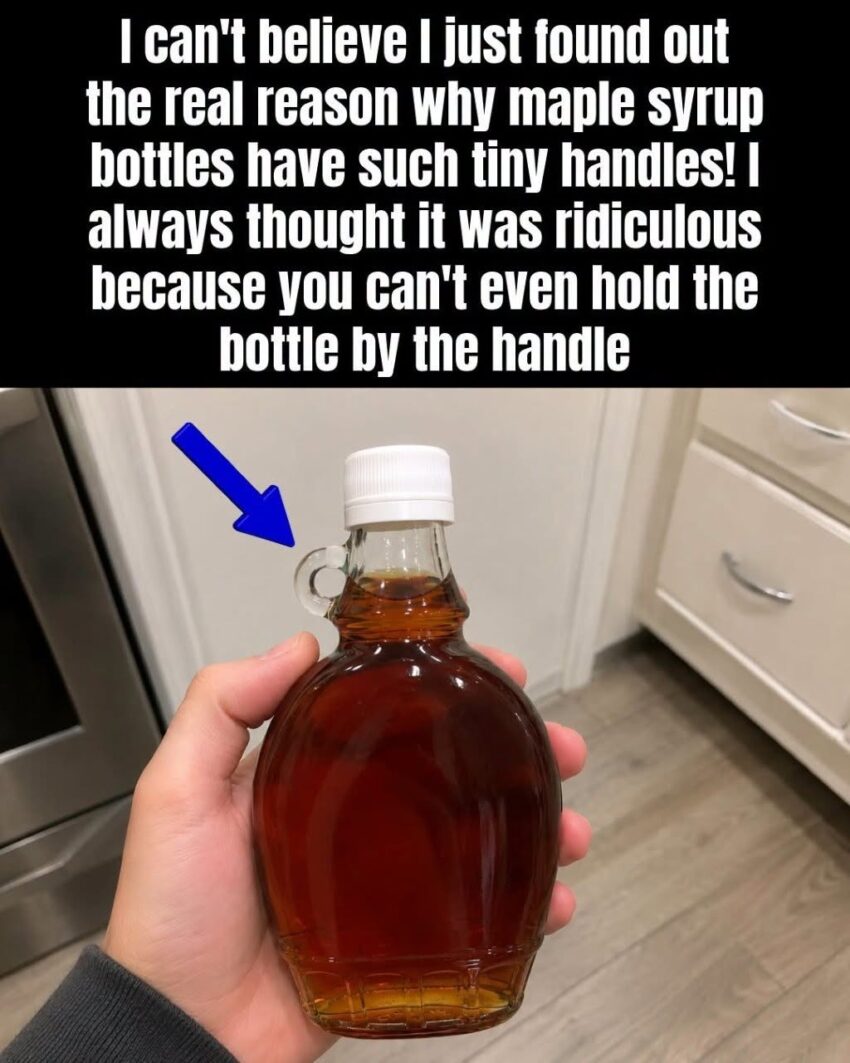
Ever wondered why traditional maple syrup bottles have those tiny little handles? Discover what they’re actually designed for and why they aren’t meant to hold the entire bottle.
If you’ve ever looked at a traditional maple syrup bottle, you may have noticed something unusual: a tiny handle attached to the neck of the bottle.
At first glance, it seems almost useless.
It’s far too small to comfortably fit your entire hand, and if you try to pick up a full bottle by that little handle, it doesn’t exactly feel secure.
So why is it there?
The answer is surprisingly simple—and it has more to do with pouring and controlling the bottle than carrying it.
The Tiny Handle Isn’t Really a Carrying Handle
One of the biggest misconceptions about these maple syrup bottles is that the little handle was designed to hold the entire bottle.
That’s generally not its main purpose.
Traditional syrup containers have often been designed so that the small handle can help provide a convenient grip near the neck of the bottle while pouring.
Instead of wrapping your entire hand around the glass container, you can use the handle and the bottle’s body together to help control the flow of syrup.
And that makes much more sense when you consider how thick maple syrup can be.
Maple Syrup Is Thick and Slow-Moving
Pure maple syrup is considerably thicker than water.
When you’re pouring it over pancakes, waffles, French toast, oatmeal, or another breakfast dish, you usually don’t want the entire contents of the bottle rushing out at once.
A controlled grip makes it easier to tilt the bottle gradually and direct the syrup exactly where you want it.
That little handle can provide an additional point of contact while you’re doing this.
Why Make the Handle So Small?
This is the part that confuses most people.
If the handle were supposed to function like the handle on a pitcher or mug, you’d expect it to be much larger.
But a syrup bottle doesn’t necessarily need a large carrying handle.
A smaller handle can:
- Provide a convenient gripping point
- Help with pouring control
- Keep the bottle compact
- Preserve the traditional appearance
- Avoid adding unnecessary glass or material
In other words, it’s not a miniature suitcase handle.
It’s more like a small functional feature that works with the shape of the bottle.
The Bottle Shape Also Matters
Traditional maple syrup containers are often designed with a broad body and narrower neck.
This shape provides a comfortable area to hold the bottle while the narrow neck makes it easier to pour.
The small handle near the neck gives you another place to position your fingers.
When pouring, you can support the bottle with one hand around its body while using your fingers near the neck or handle for additional control.
It’s Also Part of Maple Syrup Tradition
There’s another reason these little handles seem so familiar: they’ve become part of the visual identity of traditional maple syrup packaging.
Maple syrup has a long history of being packaged in glass containers, and certain bottle shapes have become strongly associated with the product.
So today, the tiny handle isn’t just a practical feature—it can also be part of the traditional design.
That’s why you may recognize the shape immediately even if you’ve never stopped to ask why it looks that way.
Does Every Maple Syrup Bottle Have a Tiny Handle?
No.
Maple syrup comes in many different types of containers, including:
- Glass bottles
- Plastic jugs
- Cans
- Squeeze bottles
- Larger commercial containers
The small glass handle is especially associated with certain traditional-style bottles.
Modern packaging may leave it out entirely because manufacturers can choose designs that are cheaper, lighter, easier to manufacture, or more convenient for consumers.
Should You Actually Pick Up the Bottle by the Tiny Handle?
It’s better not to assume that the handle is designed to support the full weight of a heavy bottle.
A glass bottle filled with syrup can be surprisingly heavy, and gripping it only by a small glass handle may be uncomfortable or could potentially place unnecessary stress on the container.
For everyday use, support the bottle by its main body and use the little handle as a secondary grip when helpful.
That gives you much better control.
A Tiny Detail With a Practical Purpose
It’s funny how many everyday objects have features we’ve never really questioned.
A small handle on a maple syrup bottle can look like a design mistake until you realize that it doesn’t need to function like a conventional handle.
Its purpose is more subtle: helping with grip and control while pouring while maintaining the familiar shape of the container.
So the next time you sit down with pancakes and a bottle of maple syrup, take a closer look.
That tiny handle isn’t necessarily ridiculous after all.
It’s a small example of how packaging design can combine function, tradition, and appearance in one little detail.
Final Thought
Sometimes the most interesting things hiding in our kitchens are the things we see every day.
That tiny maple syrup handle is a perfect example. It may look too small to be useful, but once you understand its intended role, the design starts to make much more sense.
Now that you know, would you ever look at that little handle the same way again?