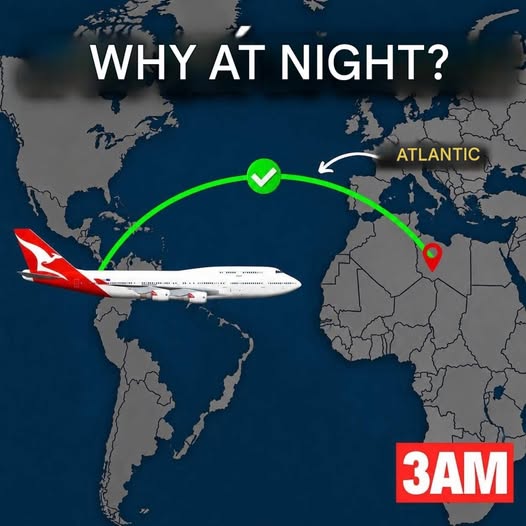
Do planes really avoid crossing the Atlantic during the day? Discover why transatlantic flights operate at all hours, how time zones affect schedules, and why some routes seem more common at night.
Have you ever looked at a flight map and wondered why so many transatlantic flights seem to happen overnight?
It can give the impression that airlines avoid crossing the Atlantic Ocean during daylight hours. But the reality is much simpler: planes absolutely do cross the Atlantic during the day. The apparent pattern is mainly caused by flight schedules, time zones, passenger preferences, and airline operations.
Planes Fly Across the Atlantic 24 Hours a Day
There is no rule preventing aircraft from crossing the Atlantic during daylight.
Commercial aircraft routinely travel between North America and Europe throughout the day and night. Whether a particular flight crosses the ocean in daylight depends on its departure time, destination, route, season, and wind conditions.
So why do overnight flights seem so common?
1. Time Zones Create the Illusion
One of the biggest reasons is the difference between North American and European time.
For example, a flight leaving the United States in the evening can arrive in Europe the following morning. On a clock, the journey appears to “skip” much of the night.
A flight leaving New York at around 7 p.m. might arrive in London or Paris the next morning.
The aircraft didn’t avoid daylight. The local clocks simply show different times at different points along the journey.
2. Airlines Schedule Flights Around Passenger Demand
Many travelers prefer overnight flights because they can sleep during the journey and arrive in Europe in the morning.
This can make overnight departures particularly attractive for airlines.
For business travelers, arriving in the morning can also provide a full working day at the destination.
3. The Return Flight Can Look Completely Different
The westbound journey often has a different schedule.
A flight from Europe to North America may leave in the morning or afternoon and arrive in North America later the same day.
This happens because you’re traveling against the direction of the Earth’s rotation and across time zones.
The actual flight time might be several hours, but the local arrival time can make the journey appear shorter on the clock.
4. Jet Streams Affect Flight Times
Airlines also consider winds when planning long-distance routes.
High-altitude jet streams can be extremely strong. Flying with favorable winds can shorten a flight, while flying against them can make it considerably longer.
This is one reason the eastbound and westbound journeys between Europe and North America don’t always take the same amount of time.
5. Aircraft Don’t Need Daylight to Navigate
Modern passenger aircraft are designed to operate safely day or night.
Pilots use sophisticated navigation systems, instruments, communications, weather information, and air-traffic-control procedures.
The aircraft doesn’t need to see the ocean or coastline below to know where it is.
In fact, commercial aviation has been routinely operating nighttime long-distance flights for decades.
What About the “Empty Atlantic” Theory?
You may have seen claims that airlines avoid daytime Atlantic crossings because the ocean is somehow more dangerous during the day.
That’s misleading.
The North Atlantic is crossed by large numbers of commercial aircraft, and flight routes are carefully planned around weather, air traffic, aircraft capabilities, and operational requirements.
There isn’t a special daytime danger that makes airlines wait until night.
Why Does the Sky Sometimes Look Empty?
If you look at a flight-tracking map at a particular moment, you may notice that some areas of the Atlantic appear to have relatively few aircraft.
That doesn’t mean planes aren’t crossing the ocean.
Flight traffic changes continuously according to:
- Time of day
- Airline schedules
- Seasonal demand
- Weather
- Aircraft availability
- Airport operations
- Air-traffic restrictions
- Preferred routes
A snapshot of the sky doesn’t tell you how much traffic passes through the region over an entire day.
The Interesting Part: Daylight Changes During the Flight
Because the Earth is curved and the flight can last several hours, an aircraft can experience different lighting conditions during one journey.
A plane may leave one city in darkness, fly through twilight, and eventually reach daylight—or the reverse.
The exact experience depends on the season, latitude, direction of travel, and departure time.
Final Takeaway
Planes do cross the Atlantic during the day. The idea that they only cross at night is largely an illusion created by airline scheduling and time-zone differences.
Overnight flights are popular because they allow passengers to sleep during the journey and arrive in Europe in the morning, while jet streams and operational considerations influence the exact timing and route.
So the next time you see a transatlantic flight listed as an “overnight” journey, remember: the aircraft isn’t avoiding the daytime Atlantic—it is simply traveling across multiple time zones.