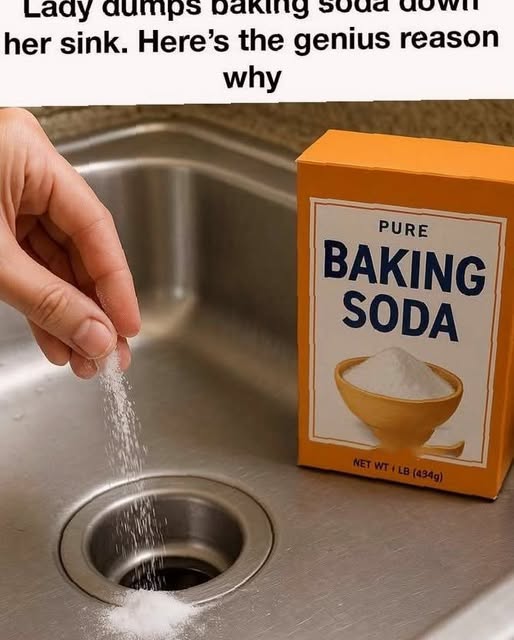
Pouring baking soda down your sink can help freshen drains and loosen light residue. Learn how to use it safely and what it can—and cannot—do.
There are plenty of household cleaning tricks that sound strange until you understand the reason behind them.
One of those tricks is surprisingly simple: pouring baking soda down the kitchen sink.
At first, it might seem pointless. After all, baking soda is a common pantry ingredient, not a specialized drain cleaner.
But baking soda can be useful for routine drain maintenance because of its mild abrasive properties and ability to help neutralize unpleasant odors.
The important part is knowing what baking soda can actually do.
It may help with light residue and odors, but it is not a substitute for professional drain cleaning when you have a serious blockage.
Why Put Baking Soda Down the Sink?
Kitchen drains can collect tiny amounts of food residue, grease, soap, and other organic material over time.
Even when water is still flowing normally, that buildup can contribute to an unpleasant smell.
Baking soda can help freshen the drain and loosen some light residue.
It is particularly useful as part of a regular cleaning routine rather than as an emergency solution for a completely blocked pipe.
The Baking Soda and Hot Water Method
One of the simplest approaches requires only baking soda and hot water.
What You Need
- About ½ cup baking soda
- Hot water
- A small funnel, if needed
Step 1: Clear the Sink
Remove dishes, food particles, and visible debris from the sink.
If there is standing water because the drain is blocked, remove as much as possible before attempting routine cleaning.
Step 2: Add the Baking Soda
Pour approximately ½ cup of baking soda directly into the drain.
Try to get as much of it into the drain opening as possible.
Step 3: Let It Sit
Allow the baking soda to sit for several minutes.
This gives it time to interact with residue around the drain.
Step 4: Flush With Hot Water
Slowly pour hot water down the drain.
The water helps carry loosened residue through the plumbing.
For routine maintenance, this simple process may help reduce odors and keep the drain feeling fresher.
What About Baking Soda and Vinegar?
You’ve probably seen another popular version of this trick:
Baking soda + vinegar.
When the two ingredients meet, they react and produce carbon dioxide bubbles.
That bubbling action can help agitate loose debris, which is why the combination is so popular in DIY cleaning recipes.
However, there is an important limitation.
The dramatic fizz does not mean that the mixture is equivalent to a commercial drain opener.
Much of the baking soda and vinegar neutralize each other during the reaction.
The combination can be useful for light cleaning and agitation, but it should not be expected to dissolve a serious clog.
A Simple Baking Soda and Vinegar Routine
If you want to try the combination for routine drain freshening, you can use a modest amount.
You Will Need
- ½ cup baking soda
- About ½ cup white vinegar
- Hot water
How to Use It
- Pour the baking soda into the drain.
- Slowly add the vinegar.
- Allow the mixture to fizz for several minutes.
- Flush the drain with hot water.
Avoid sealing the drain tightly while the mixture is actively reacting because pressure can build up.
What Baking Soda Can Help With
Baking soda is most useful for relatively minor household problems.
It may help:
Reduce Unpleasant Odors
Baking soda is commonly used as an odor absorber, making it useful when a drain smells stale or unpleasant.
Loosen Light Residue
Its mild abrasive properties can help with some surface residue.
Freshen the Drain
Used periodically, it can become part of a simple drain-maintenance routine.
Clean Around the Drain Opening
A baking soda paste can also be used to scrub some areas around the sink and drain, provided the surface is compatible with the cleaning method.
What Baking Soda Cannot Do
This is where many viral cleaning hacks become misleading.
Baking soda is not a miracle drain unclogger.
If your sink is completely blocked by a dense accumulation of grease, hair, food, or another object, baking soda may not solve the problem.
It also cannot retrieve an object that has become lodged inside the plumbing.
A persistent blockage may require:
- A sink plunger
- Cleaning the trap
- A plumbing snake
- Professional plumbing assistance
The appropriate method depends on the cause and location of the blockage.
Don’t Pour Grease Down the Sink
One of the best ways to prevent kitchen-drain problems is to avoid putting grease and cooking oil down the drain in the first place.
Liquid grease may appear harmless while it is hot, but as it cools, it can stick to plumbing surfaces and contribute to buildup.
Instead, allow used cooking oil or grease to cool and dispose of it according to local waste guidelines.
Scraping plates and pans before washing them can also reduce the amount of food entering the drain.
Use a Sink Strainer
A small sink strainer can prevent food scraps from entering the plumbing.
It won’t stop every particle, but it can make a significant difference.
Empty the strainer regularly instead of allowing food debris to sit in it.
This is especially useful for households that cook frequently.
Don’t Make This Common Mistake
Some people assume that if baking soda is good for cleaning, adding more must make it work better.
That’s not necessarily true.
Using huge quantities doesn’t automatically produce better results.
For routine drain maintenance, a moderate amount is generally sufficient.
More importantly, never mix baking soda with random household chemicals.
In particular, don’t combine cleaning products containing bleach with acids or other incompatible chemicals. Dangerous gases can be produced by some combinations.
Always follow the label directions for commercial cleaning products.
What If the Sink Is Already Clogged?
If water is draining slowly, first try to identify the likely cause.
Start with simple mechanical methods.
A properly used sink plunger may be more effective for a simple clog than repeatedly pouring cleaning ingredients down the drain.
If the sink remains blocked, the trap underneath the sink may need cleaning.
For stubborn or recurring blockages, a plumber can determine whether there is a deeper problem.
Signs You May Need Professional Help
Consider getting professional assistance if:
- The sink repeatedly becomes blocked.
- Several drains in the home are affected.
- Water backs up into another fixture.
- You notice sewage odors.
- The blockage does not respond to normal mechanical methods.
- There is leaking underneath the sink.
- You suspect a damaged or collapsed pipe.
Repeated blockages can sometimes indicate a plumbing problem rather than something that can be fixed with a household cleaning trick.
Why This Simple Trick Became Popular
The appeal of baking soda is easy to understand.
It is inexpensive, easy to find, and already present in many kitchens.
Unlike some strong chemical cleaners, it can be incorporated into a gentle household-maintenance routine when used appropriately.
That’s why a simple jar of baking soda can have multiple uses around the home.
But the smartest part of the trick isn’t simply pouring baking soda down the sink.
It’s understanding when to use it and when not to.
How Often Should You Do It?
There is no universal requirement to put baking soda down your drain on a specific schedule.
If your drain is functioning normally and doesn’t smell, you may not need to do anything special.
Some households may choose to freshen the drain occasionally as part of their cleaning routine.
The more important habits are:
- Keep food scraps out of the drain.
- Don’t pour grease down the sink.
- Keep the drain opening clean.
- Deal with slow drainage early.
- Maintain the plumbing properly.
Prevention is usually easier than dealing with a major clog later.
Other Uses for Baking Soda Around the Kitchen
Baking soda can be useful beyond the sink.
It can also be used appropriately for:
- Deodorizing refrigerators
- Cleaning some countertop surfaces
- Scrubbing certain sinks
- Removing light residue
- Freshening trash cans
- Cleaning some kitchen appliances
Always check the material and manufacturer’s cleaning instructions before using an abrasive substance on a surface.
Frequently Asked Questions
Does baking soda unclog a sink?
It can help with minor residue, but it is not a guaranteed solution for a serious blockage. Mechanical methods or professional plumbing may be necessary for stubborn clogs.
Can I put baking soda down my kitchen sink?
For most standard household drains, baking soda can be used as a simple cleaning or deodorizing ingredient. Use a reasonable amount and avoid mixing it with incompatible chemicals.
Is baking soda and vinegar safe for drains?
The reaction can be used as a household cleaning method, but it isn’t a powerful replacement for professional drain cleaning. Never mix vinegar with bleach or other incompatible cleaning products.
Can baking soda remove grease from pipes?
It may help with light residue, but hardened or substantial grease buildup may require a more effective mechanical or professional method.
How can I prevent kitchen sink clogs?
Use a drain strainer, scrape food from dishes before washing them, and never intentionally pour cooking grease or oil down the drain.
Final Thoughts
The next time you see someone pouring baking soda into a sink, don’t assume it’s just another strange internet cleaning trick.
There is a reasonable idea behind it.
Baking soda can help freshen a drain, absorb odors, and loosen light residue, making it a useful addition to an ordinary household cleaning routine.
But the real secret is knowing its limits.
It won’t magically dissolve every clog, repair damaged plumbing, or replace a plumber.
The smartest approach is to combine simple maintenance habits—keeping food and grease out of the drain, cleaning the sink regularly, and dealing with slow drainage early—with baking soda when you simply want an inexpensive way to freshen the drain.